Mysore State
| Mysore State | |||||||||
|---|---|---|---|---|---|---|---|---|---|
| State of India | |||||||||
| 1947–1973 | |||||||||
 Coat of arms
| |||||||||
.svg) Mysore State, 1951 | |||||||||
.svg) Mysore state, 1956 | |||||||||
| Capital | Bangalore | ||||||||
| Government | |||||||||
| Rajpramukh | |||||||||
• 1950–1956 | Jayachamarajendra Wadiyar | ||||||||
| History | |||||||||
• Accession of the Kingdom of Mysore to the Indian Union | 9 August 1947 | ||||||||
• Renamed Karnataka State | 1 November 1973 | ||||||||
| |||||||||
| Today part of | India | ||||||||

Mysore State, colloquially Old Mysore, was a political territory within the Dominion of India and the subsequent Republic of India from 1947 until 1956. The state was formed by renaming the Kingdom of Mysore, and Bangalore replaced Mysore as the state's capital when Parliament passed the States Reorganisation Act in 1956.[1] Mysore State was considerably enlarged when it became a linguistically homogeneous Kannada-speaking state within the Republic of India by incorporating territories from Andhra, Bombay, Coorg, Hyderabad, and Madras States, as well as other petty fiefdoms. It was subsequently renamed Karnataka in 1973.[2]
History
[edit | edit source]The Kingdom of Mysore was one of the three largest princely states in British India. Upon India's independence from Britain in 1947, Maharaja Jayachamarajendra Wadiyar signed the instrument of accession, incorporating his realm with the Union of India, on 15 August 1947. The territories of the erstwhile princely state of Mysore were then reconstituted into a state within the Union.[3]
In 1953 during the formation of Andhra, the Bellary district was transferred from Madras to Mysore.
Reorganisation
[edit | edit source]In 1956, the Government of India effected a comprehensive re-organisation of provincial boundaries, based upon the principle of shared language. As a result of the States Reorganisation Act on 1 November 1956, the Kannada-speaking districts of Belgaum (exclusing Chandgad), Bijapur, Dharwad, and North Canara were transferred from Bombay to Mysore.[4] South Canara was transferred from Madras; and Koppal, Raichur, Kalaburagi and Bidar districts from Hyderabad. Also, the small Coorg State was merged, becoming a district in Mysore.[5] The state was renamed Karnataka on 1 November 1973.[6]
-
 Map of southern India before the reorganisation of 1956 with the blue outline of the expanded Mysore State (after 1956)
 -
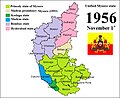 Unified Mysore State


Maharaja of Mysore
[edit | edit source]| No | Portrait | Name | Term of office | Duration | Selected former office(s) | |
|---|---|---|---|---|---|---|
| 1 | 
|
Jayachamarajendra Wadiyar | 15 August 1947 | 25 January 1950 | 2 years, 163 days | Yuvaraja of Mysore |
Rajpramukh of Mysore
[edit | edit source]| No | Portrait | Name | Term of office | Duration | Selected former office(s) | |
|---|---|---|---|---|---|---|
| 1 |
|
Jayachamarajendra Wadiyar | 26 January 1950 | 31 October 1956 | 6 years, 279 days | Maharaja of Mysore |
Governors of Mysore
[edit | edit source]| No | Portrait | Name | Term of office | Duration | Selected former office(s) | |
|---|---|---|---|---|---|---|
| 1 |
|
Jayachamarajendra Wadiyar | 1 November 1956 | 4 May 1964 | 7 years, 185 days | Maharaja of Mysore, Rajpramukh of Mysore |
| 2 | File:General Satyawant Mallana Srinagesh.jpg | S. M. Shrinagesh | 4 May 1964 | 2 April 1965 | 333 days | Chief of the Army Staff |
| 3 | File:VV Giri 1974 stamp of India (cropped).jpg | V. V. Giri | 2 April 1965 | 13 May 1967 | 2 years, 41 days | Fourth President of India |
| 4 | File:Gopal Swarup Pathak1.jpg | Gopal Swarup Pathak | 13 May 1967 | 30 August 1969 | 2 years, 109 days | Fourth Vice-president of India |
| - | – | Justice A. R. Somanath Iyer (Acting) | 30 August 1969 | 23 October 1969 | 54 days | Chief Justice of Karnataka High Court |
| 5 | File:Dharma Vir, ICS.jpg | Dharma Vira | 23 October 1970 | 1 February 1972 | 1 year, 101 days | Governor of Punjab, Haryana, and West Bengal |
| 6 | File:Mohan Lal Sukhadia 1988 stamp of India.jpg | Mohanlal Sukhadia | 1 February 1972 | 31 October 1976 | 4 years, 273 days | Chief Minister of Rajasthan, Governor of United Andhra Pradesh and Tamil Nadu |

.jpg)


Prime ministers of Mysore
[edit | edit source]| #[a] | Portrait | Name | Constituency | Term[7] (tenure length) |
Assembly[8] (election) |
Party[b] | |||
|---|---|---|---|---|---|---|---|---|---|
| 1 | File:K. C. Reddy.jpg | K. Chengalaraya Reddy | Kolar | 25 October 1947 | 26 January 1950 | 2 years, 93 days | Not established yet | Indian National Congress | |

Chief ministers of Mysore
[edit | edit source]| #[c] | Portrait | Name | Constituency | Term[7] (tenure length) |
Assembly[8] (election) |
Party[d] | |||
|---|---|---|---|---|---|---|---|---|---|
| 1 | File:K. C. Reddy.jpg | K. Chengalaraya Reddy | N/A | 26 January 1950 | 30 March 1952 | 2 years, 64 days | Not established yet | Indian National Congress | |
| 2 | File:Kengal Hanumanthaiah.gif | Kengal Hanumanthaiah | Ramanagara | 30 March 1952 | 19 August 1956 | 4 years, 142 days | 1st (1952 election) continued... | ||
| 3 | Kadidal Manjappa | Tirthahalli | 19 August 1956 | 31 October 1956 | 73 days | ||||
| Chief Minister of Mysore (following the state's reorganisation)[e] | |||||||||
| 4 | File:Siddavanahalli Nijalingappa stamp (cropped).jpg | S. Nijalingappa | Molakalmuru | 1 November 1956 | 16 May 1958 | 1 year, 197 days | ...continued 1st (1952) |
Indian National Congress | |
| 2nd (1957) | |||||||||
| 5 | File:Basappa Danappa Jatti, 5th Vice President of India.jpg | B. D. Jatti | Jamkhandi | 16 May 1958 | 14 March 1962 | 3 years, 302 days | |||
| 6 | S. R. Kanthi | Hungud | 14 March 1962 | 21 June 1962 | 99 days | 3rd (1962) | |||
| (4) | File:Siddavanahalli Nijalingappa stamp (cropped).jpg | S. Nijalingappa | Bagalkot[10] | 21 June 1962 | 29 May 1968 | 5 years, 343 days | |||
| Shiggaon | 4th (1967) | ||||||||
| 7 | Veerendra Patil | Chincholi | 29 May 1968 | 18 March 1971 | 2 years, 293 days | Indian National Congress (O) | |||
| – | File:Emblem of India.svg | Vacant[f] (President's rule) |
N/A | 19 March 1971 | 20 March 1972 | 1 year, 1 day | Dissolved | N/A | |
| 8 | File:Devaraj Urs (cropped).JPG | D. Devaraj Urs[g] | Hunsur | 20 March 1972 | 31 December 1977 | 5 years, 286 days | 5th
(1972) |
Indian National Congress (R) | |

.jpg)


.JPG)
See also
[edit | edit source]Note
[edit | edit source]- ^ A parenthetical number indicates that the incumbent has previously held office.
- ^ This column only names the chief minister's party. The state government he headed may have been a complex coalition of several parties and independents; these are not listed here.
- ^ A parenthetical number indicates that the incumbent has previously held office.
- ^ This column only names the chief minister's party. The state government he headed may have been a complex coalition of several parties and independents; these are not listed here.
- ^ On 1 November 1956, via the States Reorganisation Act, Mysore State was significantly expanded along linguistic lines. The Kannada-speaking districts of Bombay, Hyderabad and Madras states, as well as the entirety of Coorg, were added to it.[9]
- ^ President's rule may be imposed when the "government in a state is not able to function as per the Constitution", which often happens because no party or coalition has a majority in the assembly. When President's_rule#Karnataka
- ^ On 1 November 1973, via the Mysore State (Alteration of Name) Act, Mysore State was renamed as Karnataka.[9] Thus, Devaraj Urs was Chief Minister of Mysore between 20 March 1972 and 31 October 1973, and Chief Minister of Karnataka after that.
References
[edit | edit source]- ^ Lua error in Module:Citation/CS1/Configuration at line 2172: attempt to index field '?' (a nil value).
- ^ Lua error in Module:Citation/CS1/Configuration at line 2172: attempt to index field '?' (a nil value).
- ^ Lua error in Module:Citation/CS1/Configuration at line 2172: attempt to index field '?' (a nil value).
- ^ Lua error in Module:Citation/CS1/Configuration at line 2172: attempt to index field '?' (a nil value).
- ^ Lua error in Module:Citation/CS1/Configuration at line 2172: attempt to index field '?' (a nil value).
- ^ Lua error in Module:Citation/CS1/Configuration at line 2172: attempt to index field '?' (a nil value).
- ^ a b Chief Ministers of Karnataka since 1947. Karnataka Legislative Assembly. Archived on 6 December 2016.
- ^ a b Assemblies from 1952. Karnataka Legislative Assembly. Archived on 6 December 2016.
- ^ a b M. S. Prabhakara. "New names for old". The Hindu. 24 July 2007.
- ^ Lua error in Module:Citation/CS1/Configuration at line 2172: attempt to index field '?' (a nil value).
Lua error in Module:Coordinates at line 489: attempt to index field 'wikibase' (a nil value).

Lua error in Module:Authority_control at line 153: attempt to index field 'wikibase' (a nil value).