Myoepithelial cell
| Myoepithelial cell | |
|---|---|
 | |
| Details | |
| Identifiers | |
| Latin | myoepitheliocytus |
| TA98 | Lua error in Module:Wikidata at line 746: attempt to index field 'wikibase' (a nil value). |
| TH | {{#property:P1694}} |
| TE | {{#property:P1693}} |
| FMA | {{#property:P1402}} |
| Anatomical terminology [[[d:Lua error in Module:Wikidata at line 865: attempt to index field 'wikibase' (a nil value).|edit on Wikidata]]] | |
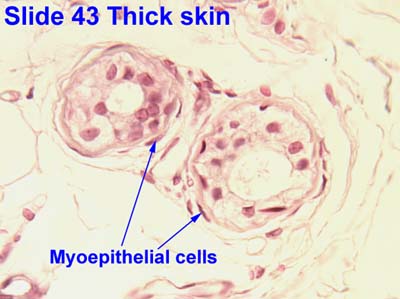
Myoepithelial cells (sometimes referred to as myoepithelium) are cells usually found in glandular epithelium as a thin layer above the basement membrane but generally beneath the luminal cells. These may be positive for alpha smooth muscle actin and can contract and expel the secretions of exocrine glands. They are found in the sweat glands, mammary glands, lacrimal glands, and salivary glands. Myoepithelial cells in these cases constitute the basal cell layer of an epithelium that harbors the epithelial progenitor. In the case of wound healing, myoepithelial cells reactively proliferate. Presence of myoepithelial cells in a hyperplastic tissue proves the benignity of the gland and, when absent, indicates cancer. Only rare cancers like adenoid cystic carcinomas contains myoepithelial cells as one of the malignant components.
It can be found in endoderm or ectoderm.[1]
Markers
[edit | edit source]Myoepithelial cells are true epithelial cells positive for keratins, not to be confused with myofibroblasts which are true mesenchymal cells positive for vimentin. These cells are generally positive for alpha smooth muscle actin (αSMA), cytokeratin 5/6 and other high molecular weight cytokeratins, p63 and caldesmon. Myoepithelial cells are stellate in shape and are also known as basket cells. They lie between the basement membrane and glandular epithelium. Each cell consists of a cell body from which 4-8 processes radiate and embrace the secretory unit. Myoepithelial cells have contractile functions. They help in expelling secretions from the lumen of secretory units and facilitate the movement of saliva in salivary ducts.
Other Cancers Involving This Type of Cell
[edit | edit source]
- Myoepithelioma of the head and neck - A (usually) benign tumor of the head/neck consisting of solely myoepithelial cells.
- Epithelial-myoepithelial carcinoma (of the salivary glands) - A low-grade malignant tumor composed of both neoplastic epithelial and neoplastic myoepithelial cells (a biphasic tumor).
- Epithelial-myoepithelial carcinoma of the lung- A malignant tumor composed of both epithelial and myoepithelial tissues whose pathology resemble salivary cells.
- Adenomyoepithelioma of the breast- A (usually) benign tumor of the breast composed of Myoepithelial and Adeno (glandular) cells.
- Myoepithelioma of the Breast- A usually benign or exceedingly rare malignant tumor of the breast which mimics IDC but with cells resembling adenoid cysts. If malignant, this is also known as a Myoepithelial Carcinoma.
See also
[edit | edit source]List of distinct cell types in the adult human body
References
[edit | edit source]- ^ Lua error in Module:Citation/CS1/Configuration at line 2172: attempt to index field '?' (a nil value).
External links
[edit | edit source]- Anatomy Atlases – Microscopic Anatomy, plate 07.141 - "Axillary Sweat Gland: Myoepithelium"
- Histology image: 43_13 at the University of Oklahoma Health Sciences Center - "thick skin"
- Histology at KUMC glands-glands09 "Simple Tubular Coiled"
- Lua error in Module:Citation/CS1/Configuration at line 2172: attempt to index field '?' (a nil value).
Lua error in Module:Authority_control at line 153: attempt to index field 'wikibase' (a nil value).
