MyWiki:Australian Wikipedians' notice board
{{Wikipedia:Australian Wikipedians' notice board/Header}}
{{Wikipedia:Australian Wikipedians' notice board/Layout
|toplefttitle=WikiProjects
|toprighttitle=In the news
|topleftbox=Portal:Australia/WikiProjects
|toprightbox=Portal:Australia/News
|middlelefttitle=Categories
|middlerighttitle=On this day in Australia
|middleleftbox=Portal:Australia/Categories
|middlerightbox=Portal:Australia/Anniversaries/Today
|bottomlefttitle=To-Do
|bottomrighttitle=Announcements
|bottomleftbox=Template:Australia opentask
|bottomrightbox=Wikipedia:Australian Wikipedians' notice board/Announcements
}}
Traditional Owners on Template:Infobox Australian place
[edit source]I believe Template:Infobox Australian place should be modified to have a field for who the Traditional Owners of the land are. IE the sydney CBD would list the eora people. Many pages list them and its common practice to list them. Thoughts? Pencilceaser123 (talk) 02:18, 18 September 2025 (UTC)
- I don't see an issue with having such a field, so long as we have policy around it. Because traditional ownership of a place is often disputed by a number of Indigenous groups, I would suggest we only put a value in that field when the article already has well-cited content to support one group of traditional owners. If the article has any indication that this is the subject of a dispute, then I suggest we follow the Neutral Point of View policy and mention both (or however many) claims in the article body (appropriately cited) but NOT put any of them into the field in the infoxbox. We could make an exception if there has been a successful application for Native Title (appropriately cited to the court determination), but I would still include the article that other claims exist. Kerry (talk) 01:40, 19 September 2025 (UTC)
- Good point, sounds like a fair policy. Perhaps a good standard that could be used would be seeing which groups are acknowledged on acknowledgements or welcomes to country made by local government organisations. But obviously many places do not make acknowledgements of country or do not mention specific groups, and they might not be specific enough for more specific areas, such as suburbs. Pencilceaser123 (talk) 01:52, 19 September 2025 (UTC)
- I started formulating a response then saw that Kerry said what I was going to say here ... so, +1, as the young people say. ClaudineChionh (she/her · talk · email · global) 02:00, 19 September 2025 (UTC)
- Agree with Kerry. The proposal raises a few issues:
- 1) My understanding is that the preferred terminology nowadays is "traditional custodians" rather than "traditional owners".
- 2) The problem is that info boxes are supposed to summarise key information and are not the place to try to present complex or contested information. MOS:INFOBOXPURPOSE.
- 3) Welcome to country speeches, websites run by different indigenous groups, and published information by sporting groups, local councils etc are often contradictory and sometimes designed to support particular claims relating to ongoing legal disputes. They are not as good as academic sources in determining the boundaries of traditional Aboriginal groups.
- 4) Unfortunately, most of the articles on Australian places and Aboriginal groups are terrible. Few are anywhere near GA or FA status. Everything in them needs to checked against reliable academic sources, preferably by distinguished anthropologists, linguists and historians.
- 5) That said, the proposal might encourage editors put some effort into finding reliable sources for traditional owners (the reasons for decision in Native Title claims, academic studies, etc).
- Of course, there are some cases where the traditional custodians of a particular area is well established. For example, the infobox for an article on the Sydney CBD could state with authority that the Gadigal (or Cadigal) were the traditional custodians.
- Please see the article on Sydney#First inhabitants of the region for one approach to the problem which was arrived at after a great deal of discussion and consensus building. Aemilius Adolphin (talk) 06:18, 19 September 2025 (UTC)
- Generally agree with this, all good points. Although I slightly disagree with point 2. I would argue the tradtional custodians is key information. But I understand its nuanced, but in most places, you could definitively state one or two groups as traditional owners. Pencilceaser123 (talk) 06:23, 19 September 2025 (UTC)
- 'Custodians' would be better than 'owners' as has been pointed out.
- It may be unclear or disputed (at least for the latter in the case of 'Eora') in terms of who should be listed as traditional custodians.
- The boundaries of administrative areas are very unlikely to align with the approximate boundaries of Aboriginal clans. There appears no equivalent for Scottish clans or kinship groups in the case of areas or localities in the Highlands.
- It is worth, regardless, discussing the Indigenous habitation of an area in the article body.
- Cheers, Will Thorpe (talk) 15:28, 23 October 2025 (UTC)
- We have discussed how the borders may not line up. In cases of dispute there will be a link in the info box to where in the article it talks about it. Personally I think it would be cool to also have this for other countries. For example the Scottish highlands as you mentioned Pencilceaser123 (talk) 21:36, 23 October 2025 (UTC)
- Can we see if we can end this discussion? Consensus seems to be supporting the idea, but problems with the little things. So that we arent bogged down forever, could we add the paramater using an internim name of whatever seems to be most popular while we discuss the permentant name? Pencilceaser123 (talk) 07:13, 5 November 2025 (UTC)
- Part of the problem is that the traditional owners did not occupy land based on the boundaries of towns, suburbs, etc as they exist today, which are the basis of most of our Wikipedia articles. Might it be better to create articles that directly represent the lands of Indigenous groups? E.g. Land of the Eora people using resources along the lines of maps like this. NB the map I linked to does have problems, as there have been successful native title claims subsequent to its publication, hence my "along the lines of", hoping for a more recent update. Kerry (talk) 01:50, 19 September 2025 (UTC)
- I was thinking in many places multiple groups could be mentioned. In the Blue Mountains the land is usually refered to as the Tradtional land of the Dharug and Gundungara people, although sometimes in the lower mountains only the Dharug people are mentioned. Many articles already say "the area is the traditional land of the X people" or "the X and Y people" so for many pages the change would be just transferring that to the wikibox. Pencilceaser123 (talk) 01:56, 19 September 2025 (UTC)
- Where there aren't disputes, adding two to the infobox probably isn't a problem. It's the disputed areas that will be the problem. Kerry (talk) 07:16, 19 September 2025 (UTC)
- Prehaps in disputed areas you could put a "see indigenous history" in the field or something. Kinda like how in battles without a clear result usually "see aftermath" is put. Pencilceaser123 (talk) 07:21, 19 September 2025 (UTC)
- Help:Infobox says they are for facts and statistics, but I guess we could put "disputed"
- linked to the section (or anchor) within the article that discusses it more fully (or even to another article if the dispute has its own article. That way there is a "fact at a glance" as per the Help, which a "see ..." isn't. My bigger concern is disputes becoming an edit war simply involving changing the infobox value back and forwards rather than making a case with cited content in the article. This is why I suggested having articles for what each group perceives as their land, which enables overlap in their claims without it creating a head-to-head argument in an article for a post-colonial place whose boundaries are usually unrelated to Indigenous history. Maybe that is the best way to achieve a "neutral point of view" in this situation and minimise on-wiki disputes given that there is a lack of written sources for pre-colonial times. Kerry (talk) 06:26, 20 September 2025 (UTC)
- I probably should say that parts of Brisbane (where I live) are disputed between the Jagera and Turrbal and this creates on-going edit wars on Wikipedia because the Jagera people made a native title claim which was refused because of the Turrbal counter-claim (so it is undetermined legally). So this may make me more sensitive to the issue of disputed claims than those who write about places which are not subject to such disputes. Kerry (talk) 06:35, 20 September 2025 (UTC)
- I have been involved in some of the Brisbane pages too, and to be fair the edit wars have settled down recently. The Brisbane page itself is a prime example of poorly sourced and misleading information on Aboriginal issues. For example, "Meanjin" (however spelled) was never a traditional name for Brisbane because there was no "Brisbane" in traditional Aboriginal culture. "Meanjin" is an English transliteration of an Aboriginal word that (probably) referred to a small piece of land within what is now Brisbane. We can say that many people (Aboriginal and non-Aboriginal) now use the word "Meanjin" to refer to Brisbane but are they really using it to refer to Brisbane as defined by the article? There are many Aboriginal groups who were the traditional custodians of land that is now a part of Brisbane and they had many different names for the land they had rights over: the Yerongpan, Chepara and Coorpooroo are a few. The tragedy is that the traditional custodian groups are gone for ever and glibly stating in an info box that "Meanjin" is the Aboriginal name for Brisbane is one more erasure of the diversity of pre-colonial Australia. If we want to list traditional custodians and traditional names in an info box I would be inclined to just put: "many" and explain the detail in the articles. Aemilius Adolphin (talk) 07:33, 20 September 2025 (UTC)
- Putting "many" in the wikibox is deffinitly a good idea for larger areas or areas with multiple peoples. Prehaps you could put "many" if 4 or more groups could be considered custodians of the area. Pencilceaser123 (talk) 02:50, 21 September 2025 (UTC)
- This seems very unusual to me, although I understand how this can happen. In areas where I have lived its common to mention 2 (or even 3!) peoples as the tradtional Custodians. So I dont see why we couldnt just put both on the wikibox. Your idea for having an article for the lands of each group is great. Its just theres hundreds of countries, many of whom have wikipedia pages that are little more than stubs, so it seems along way to be able to do that. Pencilceaser123 (talk) 02:49, 21 September 2025 (UTC)
- Also I think its worth noting: When I was making this proposal I was thinking to be considered a custodian/owner of the land they would only need to lay claim to part of the area, not all of it. Pencilceaser123 (talk) 02:52, 21 September 2025 (UTC)
- I would suggest that, normally, only one traditional custodian should appear in the infobox. For large-area places (cities, large state or national parks) that have different custodians in different parts, a second custodian can be added. For pretty-much point places (towns), one only. If there are more than 2, or any dispute, or lack of good references, put nothing in the infobox and discuss the topic in the body of the article. So I would argue for
|traditional_custodian1=and|traditional_custodian2=. - I would also suggest
|traditional_custodian1_footnotes=and|traditional_custodian2_footnotes=, partly as a reminder to editors that the statement(s) need to be referenced, especially if there is little or nothing in the article body. - Question: where in the infobox should this appear? My suggestion would be with the 'larger areas this place is in' items (LGA, region, electorates), but I'm not wedded to it. Innesw (talk) 01:32, 23 September 2025 (UTC)
- Having only one custodian for single points is problematic. Aboriginal people didnt have set borders, and nations could share land. For example the dharug and gundungurra people Pencilceaser123 (talk) 04:47, 23 September 2025 (UTC)
- As for where it should be in the wikibox, thats a great idea. As is the reminder for references Pencilceaser123 (talk) 04:48, 23 September 2025 (UTC)
- OK, happy to widen the criteria for 2 custodians to (a) large places and (b) where custodionship is shared or overlaps. But I think 2 is a reasonable limit for the infobox - anything more complicated or disputed needs a longer explanation elsewhere. There is a precedent for linking to a section of the body of the article from this infobox, if
|near=is defined but all of the near-* are blank. So for any custodianship more complex that 2 verified (& undisputed) names, we could advise|traditional_custodian1=see {{slink||Traditional Custodians}}(or whatever the section name is), which will appear as 'see § Traditional Custodians'. Innesw (talk) 12:28, 23 September 2025 (UTC)
- Having only one custodian for single points is problematic. Aboriginal people didnt have set borders, and nations could share land. For example the dharug and gundungurra people Pencilceaser123 (talk) 04:47, 23 September 2025 (UTC)
- I would suggest that, normally, only one traditional custodian should appear in the infobox. For large-area places (cities, large state or national parks) that have different custodians in different parts, a second custodian can be added. For pretty-much point places (towns), one only. If there are more than 2, or any dispute, or lack of good references, put nothing in the infobox and discuss the topic in the body of the article. So I would argue for
- Also I think its worth noting: When I was making this proposal I was thinking to be considered a custodian/owner of the land they would only need to lay claim to part of the area, not all of it. Pencilceaser123 (talk) 02:52, 21 September 2025 (UTC)
- I have been involved in some of the Brisbane pages too, and to be fair the edit wars have settled down recently. The Brisbane page itself is a prime example of poorly sourced and misleading information on Aboriginal issues. For example, "Meanjin" (however spelled) was never a traditional name for Brisbane because there was no "Brisbane" in traditional Aboriginal culture. "Meanjin" is an English transliteration of an Aboriginal word that (probably) referred to a small piece of land within what is now Brisbane. We can say that many people (Aboriginal and non-Aboriginal) now use the word "Meanjin" to refer to Brisbane but are they really using it to refer to Brisbane as defined by the article? There are many Aboriginal groups who were the traditional custodians of land that is now a part of Brisbane and they had many different names for the land they had rights over: the Yerongpan, Chepara and Coorpooroo are a few. The tragedy is that the traditional custodian groups are gone for ever and glibly stating in an info box that "Meanjin" is the Aboriginal name for Brisbane is one more erasure of the diversity of pre-colonial Australia. If we want to list traditional custodians and traditional names in an info box I would be inclined to just put: "many" and explain the detail in the articles. Aemilius Adolphin (talk) 07:33, 20 September 2025 (UTC)
- I probably should say that parts of Brisbane (where I live) are disputed between the Jagera and Turrbal and this creates on-going edit wars on Wikipedia because the Jagera people made a native title claim which was refused because of the Turrbal counter-claim (so it is undetermined legally). So this may make me more sensitive to the issue of disputed claims than those who write about places which are not subject to such disputes. Kerry (talk) 06:35, 20 September 2025 (UTC)
- Prehaps in disputed areas you could put a "see indigenous history" in the field or something. Kinda like how in battles without a clear result usually "see aftermath" is put. Pencilceaser123 (talk) 07:21, 19 September 2025 (UTC)
- Where there aren't disputes, adding two to the infobox probably isn't a problem. It's the disputed areas that will be the problem. Kerry (talk) 07:16, 19 September 2025 (UTC)
- I was thinking in many places multiple groups could be mentioned. In the Blue Mountains the land is usually refered to as the Tradtional land of the Dharug and Gundungara people, although sometimes in the lower mountains only the Dharug people are mentioned. Many articles already say "the area is the traditional land of the X people" or "the X and Y people" so for many pages the change would be just transferring that to the wikibox. Pencilceaser123 (talk) 01:56, 19 September 2025 (UTC)
- I'd support the concept, and support adding a field to the infobox, but only use it when it's clear and unambiguous, with only one group. If it needs a list, then it needs an explanation too. There are lots of modern towns which are clearly in the territory of only one traditional custodial group. There are also lots of more complex areas where different groups used the same territory at different times of year, or shared border regions. There have also been shifts over time - should "traditional" refer to the timestamp of white colonisation of the state, or of initial white exploration (before they left Smallpox and measles)? Sometimes it's not even clear if the named group exists/ed or is/was part of a larger grouping. There are also more modern competing claims for recognition of Native Title. --Scott Davis Talk 01:50, 27 September 2025 (UTC)
- I’ll make a proper reply. But I think it’s fine if two different groups can be listed at the same time, more? Maybe not Pencilceaser123 (talk) 06:14, 27 September 2025 (UTC)
- I generally agree with the concept as described by Kerry, though I have some issues around how we describe it. Think Traditional Owners are not equal to Native Title holders. Within that the ability to have multiple groups is necessary. There are significant over laps between current(Government authorities if one likes) boundaries to those of Traditional Owners, and Native Title groups. Example SWLAC is Native Title holder for South West, but Yuet, Minang, Ballardong, Whadjuk et el are the TO of different areas within the single Native Title Claim. Gnangarra 12:05, 27 September 2025 (UTC)
It seems like there are possibly 4 concepts we could be referring to here (there may be more). (See Native title in Australia.)
- Native Title Determinations under the federal Native Title Act
- Indigenous Land Use Agreements made under the same act
- Other settlments made by various states (eg: under the Traditional Owner Settlement Act 2010 in Victoria)
- Traditional Custodianship - allocation of land areas to traditional first-nations groups as their pre-European-settlement - or current - areas of occupation or affiliation
The first three are legal concepts that give particular first-nations groups particular rights over particular areas of land. The fourth can probably be said to apply to 100% of Australia, with the boundaries more- or less-precisely defined, depending on the source of the information. This will generally be the group specified (if there is one) in an Acknowledgement of Country: We acknowledge the [..] people as the traditional custodians of the land on which we meet ....
So, on what basis do we include the name of a first-nations group in the Infobox under 'Traditional Custodians'? I would think any 'place' that is within or immediately surrounded by an area covered by any of the first 3 formal concepts - for a single named group - could rightly use the name of that group. For legal determinations/settlements with more than one named group, or for any statement based on #4, we need either to examine the details of those determinations/settlements, or use other reliable references. (And does an Acknowledgement of Country meet the reliability required? Of itself, I would think probably not.)
Together with the criteria (stated above) about two possible custodians, and complexity/ambiguity/disputes, does this move us closer to a set of guidelines? Innesw (talk) 12:44, 28 September 2025 (UTC)
- Acknowledgement of Country is used by agents that arent the traditional owner ie Government departments. To do a "Welcome to Country" one must be from the country and have the rights bestowed by Elders to represent that country. As a reliable source an Acknowledgement can be fraught with issues, inaccuracies, or disputes, it not something I'd be comfortable with asserting as reliable source. Use of Traditional Custodians I would be uncomfortable with, preference to use Traditional Owners which is more self explanatory. Gnangarra 13:43, 28 September 2025 (UTC)
- I think we are in furious agreement about 'Acknowledgements' as a reliable source - they just aren't. Unfortunately 'Welcomes' are probably also not sufficient, particularly if there are disputes and somebody has to decide who to invite to do one. As I said previously, any level of complexity etc. needs the Infobox to refer readers to a detailed discussion, not look as if a definitive statement can be made. On 'Custodians' and 'Owners', there does not seem to be agreement on this amongst first-nations groups (see here - which is my only source for this). Maybe just 'First Nations' as an Infobox
headingrow label? (That's just a new idea I've had, completely un-thought-through.) Innesw (talk) 22:17, 28 September 2025 (UTC)- I've been to events where acknowledges/welcomes have attracted an outburst from someone in the crowd disagreeing with which group was mentioned (or not mentioned). It's far from universally agreed. That's why I suggested writing articles about the Traditional lands of different groups as a way to document what the different groups believe and not create issues of having that information in the same article (creating edit wars). Kerry (talk) 02:06, 12 October 2025 (UTC)
- So, as far as the Infobox is concerned, our guideline needs to say (along the lines of) 'If there is any level of dispute, link to a description of that dispute. If there is no such description in WP [eg: if one of your proposed articles doesn't exist yet], then do not fill this parameter.' Innesw (talk) 12:12, 13 October 2025 (UTC)
- I've been to events where acknowledges/welcomes have attracted an outburst from someone in the crowd disagreeing with which group was mentioned (or not mentioned). It's far from universally agreed. That's why I suggested writing articles about the Traditional lands of different groups as a way to document what the different groups believe and not create issues of having that information in the same article (creating edit wars). Kerry (talk) 02:06, 12 October 2025 (UTC)
- I think we are in furious agreement about 'Acknowledgements' as a reliable source - they just aren't. Unfortunately 'Welcomes' are probably also not sufficient, particularly if there are disputes and somebody has to decide who to invite to do one. As I said previously, any level of complexity etc. needs the Infobox to refer readers to a detailed discussion, not look as if a definitive statement can be made. On 'Custodians' and 'Owners', there does not seem to be agreement on this amongst first-nations groups (see here - which is my only source for this). Maybe just 'First Nations' as an Infobox
Below is a draft section for the template documentation page. I have gone with 'First Peoples' as a base parameter name, but this, as the rest of the draft, remains open to discussion.
Parameters:
|first_peoples1=,|first_peoples2=. Give the names of the first (Aboriginal or Torres-Strait-Islander) people(s) who occupied the place prior to European settlement, or who are the traditional custodians/owners of the land.
- use these parameters where the place is within or immediately surrounded by an area affiliated with a group named in the sources (see below)
- filling first_peoples2 is valid for large-area places (eg: cities) that have different custodians in different parts, or where affiliation is acknowledged as shared
- if there are more than 2 groups sharing affiliation to the place, or there is any level of dispute or ambiguity, use 'see {{section link}}' to refer to a discussion of the details within the article, or to link to details elsewhere. If there is no detailed discussion to refer to, and there is some dispute or ambiguity, do not fill these parameters.
|first_peoples1_footnotes=,|first_peoples2_footnotes=. References demonstrating the named first peoples' affiliation.
- Common sources would include:
- Native Title Determinations under the federal Native Title Act
- Indigenous Land Use Agreements made under the same act
- Declared Indigenous Protected Areas
- Other settlements made by various states (eg: under the Traditional Owner Settlement Act 2010 in Victoria)
- Anthropological or similar information about pre-european-settlement occupation or current affiliation with the land
- Note that acknowledgements of and welcomes to country are not generally regarded as reliable sources for the name(s) of first peoples affiliated with a place.
Innesw (talk) 23:36, 22 October 2025 (UTC)
- Sounds good to me! Thanks for doing this! A few thoughts:
- Maybe something could be added to specify that the group does not need to be considered traditional custodians over the whole location, just at least one place within the modern borders.
- Maybe we could add to common sources official statements by local councils?
- No major problems though, and open to discussion on this. Pencilceaser123 (talk) 23:51, 22 October 2025 (UTC)
- I strongly oppose using statements by local government as a reliable source for traditional owners. Local government websites are not academic sources and their policies towards local indigenous groups often change depending on who is in power. There are also often disputes between indigenous groups and local governments about these very issues. There are exceptions when local government websites publish anthropological or similar information about pre-European-settlement, occupation or current affiliation with the land. A good example of this is the City of Sydney's.Barani website. Aemilius Adolphin (talk) 00:05, 23 October 2025 (UTC)
- I agree with you, im more meaning in areas where there isnt dispute. Pencilceaser123 (talk) 00:06, 23 October 2025 (UTC)
- Well, if there is no dispute then we can probably find a better source that a local government website. Your other point raises a difficulty: what if there are some Aboriginal groups that are only associated with a small part of the geographic area covered by the article? (Say, 5%). If we give them equal weight to the majority group, we are likely to be presenting disputed or misleading information. If we exclude them, we are erasing them from history. If we include an explanatory note then we are presenting complex information which probably shouldn't be in the info box. Aemilius Adolphin (talk) 00:10, 23 October 2025 (UTC)
- I suppose you could do it like this? "People A (Majority)" "People B (Minority)" or "People A" "People B (West only)" or something Pencilceaser123 (talk) 00:15, 23 October 2025 (UTC)
- I don't think even short comments like '(Majority)' or '(West only)' belong in an infobox. It's for summaries of key facts that should appear in detail elsewhere in the article. It could well be argued that if there is no detail of first nations affiliations in the article then these fields should be left blank. Innesw (talk) 23:03, 29 October 2025 (UTC)
- I suppose you could do it like this? "People A (Majority)" "People B (Minority)" or "People A" "People B (West only)" or something Pencilceaser123 (talk) 00:15, 23 October 2025 (UTC)
- Well, if there is no dispute then we can probably find a better source that a local government website. Your other point raises a difficulty: what if there are some Aboriginal groups that are only associated with a small part of the geographic area covered by the article? (Say, 5%). If we give them equal weight to the majority group, we are likely to be presenting disputed or misleading information. If we exclude them, we are erasing them from history. If we include an explanatory note then we are presenting complex information which probably shouldn't be in the info box. Aemilius Adolphin (talk) 00:10, 23 October 2025 (UTC)
- I agree with you, im more meaning in areas where there isnt dispute. Pencilceaser123 (talk) 00:06, 23 October 2025 (UTC)
- I strongly oppose using statements by local government as a reliable source for traditional owners. Local government websites are not academic sources and their policies towards local indigenous groups often change depending on who is in power. There are also often disputes between indigenous groups and local governments about these very issues. There are exceptions when local government websites publish anthropological or similar information about pre-European-settlement, occupation or current affiliation with the land. A good example of this is the City of Sydney's.Barani website. Aemilius Adolphin (talk) 00:05, 23 October 2025 (UTC)
- This is excellent work. Thanks for doing this. Aemilius Adolphin (talk) 00:06, 23 October 2025 (UTC)
The more important question is how the proposed parameter should be displayed in Template:Infobox settlement. Where in the infobox should it appear, and what heading should be used? -- Michael Bednarek (talk) 04:35, 23 October 2025 (UTC)
- @Michael Bednarek: as of the current state of the proposed wrapper to {{Infobox settlement}}, it would fit at
|subdivision_type5=First People(s), so below the LGA and above the Location (=distances & directions from other places). As shown, my suggestion for the heading is 'First People(s)'. If first_peoples2 is filled, the single|subdivision_name5=would have to be filled with (I think) a {{plainlist}}. - I'll raise the topic at the talkpage where the wrapper details are being discussed. Innesw (talk) 07:04, 23 October 2025 (UTC)
- Why would Wikipedia use 'First People(s)' in capitals? -- Michael Bednarek (talk) 10:25, 23 October 2025 (UTC)
- Fair point, I hadn't really thought about it. I'll change it to 'First people(s)' when things calm down over there! Innesw (talk) 10:40, 23 October 2025 (UTC)
- Why would Wikipedia use 'First People(s)' in capitals? -- Michael Bednarek (talk) 10:25, 23 October 2025 (UTC)
My only concern is that |subdivision_type5=First People(s) is not intuative as common terminology is to use traditional owners Gnangarra 11:44, 23 October 2025 (UTC)
- Iirc if your using visual editing and search say “aboriginal” it will show up with that parameter if it’s in the description for that parameter includes that word Pencilceaser123 (talk) 21:38, 23 October 2025 (UTC)
- The options at the moment seem to be 'traditional owners', 'traditional custodians', 'first peoples' and 'first nations'. As per here there are different traditional groups who would prefer not to use both #1 and #2, so #3 or #4 attempt to avoid that issue. But maybe term-recognition in the wider user community is more important than not using #1 or #2. I have no idea on what grounds we would resolve this. Innesw (talk) 23:32, 23 October 2025 (UTC)
- I here first nations more often personally if that changes anything Pencilceaser123 (talk) 23:33, 23 October 2025 (UTC)
- Unfortunately all these terms are disputed and we risk getting bogged down in semantic disputes. As per wikipedia policy, we should use the terms most commonly used in Australian English. If it is possibly to produce an NGRAM restricted to Australian publications we can then run the various terms and see which is the most common. My guess is it will be "Indigenous Australians" and "traditional owners", but I am happy to go with the most common results. Aemilius Adolphin (talk) 02:29, 24 October 2025 (UTC)
- Indigenous Custodians is probably most common nowadays, followed by tradtional owners. Let me see what I can find Pencilceaser123 (talk) 02:33, 24 October 2025 (UTC)
- Cant find one specifically for australia, but from what I can tell, Indigenous owners seems to be the most common Pencilceaser123 (talk) 02:46, 24 October 2025 (UTC)
- That looks like an 'I hear more often', a 'my guess', an 'is probably' and a 'seems to be' - not exactly solid grounds for a decision. :(( (That may sound a little sarcastic - please take it in the humorous tone that's intended - but unfortunately it's also true.) Anybody have thoughts on somewhere authoritative we can turn to? Innesw (talk) 09:25, 27 October 2025 (UTC)
- Uluru Statement use First Nations and First Soveriegn Nations, thats were the largest consensus has taken place in the last 30 years. On a technical level that is still where places are located on that soveriegn land. Gnangarra 10:01, 27 October 2025 (UTC)
- That looks like an 'I hear more often', a 'my guess', an 'is probably' and a 'seems to be' - not exactly solid grounds for a decision. :(( (That may sound a little sarcastic - please take it in the humorous tone that's intended - but unfortunately it's also true.) Anybody have thoughts on somewhere authoritative we can turn to? Innesw (talk) 09:25, 27 October 2025 (UTC)
- Cant find one specifically for australia, but from what I can tell, Indigenous owners seems to be the most common Pencilceaser123 (talk) 02:46, 24 October 2025 (UTC)
- Indigenous Custodians is probably most common nowadays, followed by tradtional owners. Let me see what I can find Pencilceaser123 (talk) 02:33, 24 October 2025 (UTC)
I've capitalised "Aboriginal", per convention. Mitch Ames (talk) 13:01, 23 October 2025 (UTC)
Folks, can we please NOT forget that anything in an infobox that might be challenged (and this is likely to be the case here) must be in the article with appropriate citations and that the infobox field is merely a summary of the article content. I would say first add the information to the article body and then later add it to the infobox. And I don't think an infobox with a plainlist of a large number of "5% claims" (perhaps with a number of citations) is very helpful to the reader. If it's a long-ish list, then don't try to summarise it in the infobox, just explain it in the article (appropriately cited). These are the normal principles of infoboxes, which are intended for simple "fast facts" not a complicated story. As to naming the field, what heading would you put in the article for that information e.g. "Traditional owners"? Maybe we should try to be consistent with heading and the infobox field name (might make it easier for the reader, particularly if they are not Australian). Kerry (talk) 00:12, 3 November 2025 (UTC)
- Unless in a specific situation, please use "Indigeneous" rather than "Aboriginal" as the generic terms so theTorres Strait islanders are not excluded. Kerry (talk) 00:15, 3 November 2025 (UTC)
- Limiting the number of entries to 2 (by having just first_peoples1 and first_peoples2) was intended to keep the infobox display simple. It was suggested elsewhere that we could have just a single parameter (first_peoples), and allow filling it with a {{plainlist}} of any desired size. I agree with Kerry - that idea (or any qualifications to the names like '(5%)') would allow too much complication in the infobox.
- I agree also that the field name and the heading should be the same. I'm inclined to take up Gnangarra's implication that 'First Nations' for both is the way to go, but the issue does not seem settled yet. Innesw (talk) 10:52, 3 November 2025 (UTC)
- There being no further comments, and unless there are any more, I intend to get
|first_nations1=,|first_nations2=,|first_nations1_footnotes=and|first_nations2_footnotes=added to the template, to produce 'First Nations' as an item heading. And I'll add the above draft note (with just the change from 'First Peoples' to 'First Nations') to the documentation. Innesw (talk) 00:23, 16 November 2025 (UTC)
- There being no further comments, and unless there are any more, I intend to get
- I am just concerned about Wikipedia being criticised for inaccuracy similar to what happened in 2024 about place names. Place names are such a tricky thing [1][2], [3]
- Australia Post has a campaign suggesting that people add what country they are in, but they have avoided the issue by suggesting you contact AIATSIS, who suggest you contact the local council and first nation groups. (Interestingly, I just found out that the first nation map has a restriction preventing its use in geospatial data, and has a disclaimer "The AIATSIS map serves as a visual reminder of the richness and diversity of Aboriginal and Torres Strait Islander Australia. It was created in 1996 and is not a representation of Traditional Land Owners, Languages or communities.") Wakelamp d[@-@]b (talk) 14:39, 18 November 2025 (UTC)
- The traditional owners of a place can be a matter of dispute between various Indigenous groups. Hence, the importance of reliable citations if we incorporate this kind of information into articles, but, as you say, where do we find reliable citations? Clearly native title determination in the courts are good citations, but after that, it becomes more problematic. Many people have pointed me at the AIATISIS map over the years but I don't use it because it is from 1996 using 1994 data (as it says below the map) and it does not show (for example) the Quandamooka people as the traditional owners of Stradbroke Island (which is native title court determination since then). But if we can't look to AIATSIS for such information, then where do we look? This is why in the article body, we might have to work with claims that are made but be clear that these are claims, as in "The SuchAndSuch people claim to be the traditional owners of Wherever [best cite available]" and obviously include any other claims made by other groups. I would suggest not adding claims to the infobox as the reduced space available in the infobox does not allow for the more nuanced clarification that this is a claim, unless perhaps we put "SuchAndSuch (claim)" in the infobox field? Kerry (talk) 00:53, 19 November 2025 (UTC)
- I don't think this impacts whether we can have
|first_nations*=statements in the Infobox - so long as they are verifiable statements from reliable sources. At least for some geographical areas, these do exist. Unfortunately there will be other areas where we may not be able to find references that meet the (fairly strict) criteria WP imposes. - I continue to think that anything other than just the names of one or two first nations groups (with their reference numbers) should not be in the infobox. Anything more complex, to the slightest degree, needs elaboration elsewhere, and the infobox should simply link to that elaboration - or if it doesn't exist, leave the
|first_nations*=items blank. Innesw (talk) 09:45, 20 November 2025 (UTC)
- I don't think this impacts whether we can have
- @Kerry Raymond With reliable references, I thought I would check the situation for Victoria
- In Victoria, we have three ways of deciding ownership
- Registered Aboriginal Party (RAP) which represent First Nation owners
- Traditional Owner Settlement Agreement (TOSA) which aligns with RAP, although 25 % are still being discussed
- Federal Court Decisions ([4] plus more recent ones including Melbourne)
- The first peoples' relations website links to this map does allow search by town, address .... (The map is supposed to allow search by postcode, but I couldn't get it to work).
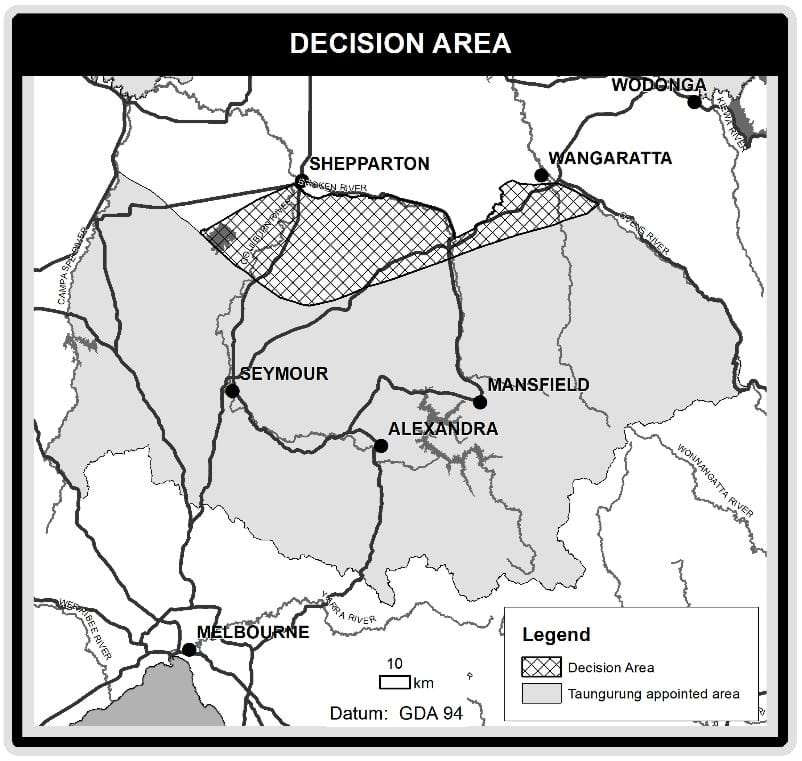
- The Aboriginal Heritage Council Request for Boundary Variation do not seem to be there, but maybe they have been acted on as some are from 2007? As an example, a request for variation is against this area south of Shepparton Victoria by the Taungurung Land and Waters Council, but it shows Yorta Yorta only.
- In Victoria, we have three ways of deciding ownership
- Things that don't seem to have anything to do with first nation areas directly
- It might be possible to use the Victorian Government ARCGIS to pull the First Nation ownership by postcode, but does a query break [WP:NOR]? Wakelamp d[@-@]b (talk) 09:13, 28 November 2025 (UTC)
- If there are reliable sources, great! Go for it! Re the use of GIS, I don't see a problem. While I am not personally familiar with the Vic Govt GIS, I use the Qld Govt GIS a lot myself. Just because information is displayed as a map overlay doesn't make it any less reliable than a book or webpage that states the same information in text or a table. The format of the source isn't the issue, it's the credibility of the information provider wrt to the kind of information provided, which in this case is the Victorian Government, so I would say that's a reliable source. Kerry (talk) 00:10, 29 November 2025 (UTC)
- @Kerry Raymond BUT If we pulled ALL the First Nation information to create an article in Wikipedia, would that be original research? Wakelamp d[@-@]b (talk) 11:27, 29 November 2025 (UTC)
- No. As per Wikipedia:No original research, On Wikipedia, original research means material—such as facts, allegations, and ideas—for which no reliable, published source exists. The Victorian Govt GIS is a published source. The only question is whether that secondary source (the Vic Govt) is considered reliable source of that kind of information. Original research is when you publish your own ideas or theories without any process of review by others knowledgable about that topic area. Claims in relation to traditional land are often disputed by Indigeneous groups, so whatever the Vic Govt or any other normally reliable source thinks on that topic might be challenged. So then we have to defer to WP:NPOV and present all claims appropriately sourced (but taking into account the issue of due and undue weight). If someone had made a map in 1769 showing the traditional lands across Australia, things would be a lot easier, but that map does not exist. Indigenous knowledge is largely dependent on oral tradition. It would obviously be nice to know where the Vic Govt gets their information that they use to create their map layers. The Qld GIS often points to their data source for their layers; does the Vic Govt do the same? The fact that you say traditional lands are linked to postcodes does seem a bit strange to me (postcodes being a relatively recent addressing tool), but it may be simply that both layers are being superimposed and there is no implied connection between the two. As Wikipedia usually has articles written about towns, suburbs, and localities in Victoria rather than articles about postcodes, I would have thought towns, suburbs, and localities were were more appropriate granularities to write about traditional owners than postcodes. Kerry (talk) 23:45, 29 November 2025 (UTC)
- It took me a little time to determine a publisher for the Victorian map. It's linked to from this page, and the only copyright statement I could find is at a link at the bottom of that page. The title is also from that page. The best I could do was
{{cite map|title=Map of formally recognised Traditional Owners|url=https://achris.vic.gov.au/weave/wca.html|publisher=State Government of Victoria|accessdate=5 December 2025}}. Unfortunately searches don't create a more specific url. Is this as good as we can do in this case? Innesw (talk) 11:53, 5 December 2025 (UTC)- It's always a challenge to cite on-line services of this nature. In the domain name "achris" is short for "Aboriginal Cultural Heritage Register and Information System", so we could add that additionally as the website parameter to what you propose. I would suggest creating a template for the whole citation so it becomes easier for people to cite, e.g. <ref>{{TraditionalOwnersVIC}}</ref> (or whatever people want the template name to be) AND it makes it easier to update when the Victorian Government inevitably changes the URL or some other detail. Then you just have to fix one template to the correct URL and not every citation. I'd be inclined to choose a template name which lends itself to something similarly named for other states, e.g. {{TraditionalOwnersNSW}} etc should we can find a generally reliable method for that state. Kerry (talk) 23:36, 5 December 2025 (UTC)
- I've created {{FirstNationsRefVIC}}, which produces
User:Innesw/sandbox/Template:FirstNationsRefVICIt does require|access-date=to be set to avoid an error message in {{cite map}}. Innesw (talk) 21:19, 10 December 2025 (UTC)
- I've created {{FirstNationsRefVIC}}, which produces
- It's always a challenge to cite on-line services of this nature. In the domain name "achris" is short for "Aboriginal Cultural Heritage Register and Information System", so we could add that additionally as the website parameter to what you propose. I would suggest creating a template for the whole citation so it becomes easier for people to cite, e.g. <ref>{{TraditionalOwnersVIC}}</ref> (or whatever people want the template name to be) AND it makes it easier to update when the Victorian Government inevitably changes the URL or some other detail. Then you just have to fix one template to the correct URL and not every citation. I'd be inclined to choose a template name which lends itself to something similarly named for other states, e.g. {{TraditionalOwnersNSW}} etc should we can find a generally reliable method for that state. Kerry (talk) 23:36, 5 December 2025 (UTC)
- It took me a little time to determine a publisher for the Victorian map. It's linked to from this page, and the only copyright statement I could find is at a link at the bottom of that page. The title is also from that page. The best I could do was
- No. As per Wikipedia:No original research, On Wikipedia, original research means material—such as facts, allegations, and ideas—for which no reliable, published source exists. The Victorian Govt GIS is a published source. The only question is whether that secondary source (the Vic Govt) is considered reliable source of that kind of information. Original research is when you publish your own ideas or theories without any process of review by others knowledgable about that topic area. Claims in relation to traditional land are often disputed by Indigeneous groups, so whatever the Vic Govt or any other normally reliable source thinks on that topic might be challenged. So then we have to defer to WP:NPOV and present all claims appropriately sourced (but taking into account the issue of due and undue weight). If someone had made a map in 1769 showing the traditional lands across Australia, things would be a lot easier, but that map does not exist. Indigenous knowledge is largely dependent on oral tradition. It would obviously be nice to know where the Vic Govt gets their information that they use to create their map layers. The Qld GIS often points to their data source for their layers; does the Vic Govt do the same? The fact that you say traditional lands are linked to postcodes does seem a bit strange to me (postcodes being a relatively recent addressing tool), but it may be simply that both layers are being superimposed and there is no implied connection between the two. As Wikipedia usually has articles written about towns, suburbs, and localities in Victoria rather than articles about postcodes, I would have thought towns, suburbs, and localities were were more appropriate granularities to write about traditional owners than postcodes. Kerry (talk) 23:45, 29 November 2025 (UTC)
- @Kerry Raymond BUT If we pulled ALL the First Nation information to create an article in Wikipedia, would that be original research? Wakelamp d[@-@]b (talk) 11:27, 29 November 2025 (UTC)
- If there are reliable sources, great! Go for it! Re the use of GIS, I don't see a problem. While I am not personally familiar with the Vic Govt GIS, I use the Qld Govt GIS a lot myself. Just because information is displayed as a map overlay doesn't make it any less reliable than a book or webpage that states the same information in text or a table. The format of the source isn't the issue, it's the credibility of the information provider wrt to the kind of information provided, which in this case is the Victorian Government, so I would say that's a reliable source. Kerry (talk) 00:10, 29 November 2025 (UTC)
- The traditional owners of a place can be a matter of dispute between various Indigenous groups. Hence, the importance of reliable citations if we incorporate this kind of information into articles, but, as you say, where do we find reliable citations? Clearly native title determination in the courts are good citations, but after that, it becomes more problematic. Many people have pointed me at the AIATISIS map over the years but I don't use it because it is from 1996 using 1994 data (as it says below the map) and it does not show (for example) the Quandamooka people as the traditional owners of Stradbroke Island (which is native title court determination since then). But if we can't look to AIATSIS for such information, then where do we look? This is why in the article body, we might have to work with claims that are made but be clear that these are claims, as in "The SuchAndSuch people claim to be the traditional owners of Wherever [best cite available]" and obviously include any other claims made by other groups. I would suggest not adding claims to the infobox as the reduced space available in the infobox does not allow for the more nuanced clarification that this is a claim, unless perhaps we put "SuchAndSuch (claim)" in the infobox field? Kerry (talk) 00:53, 19 November 2025 (UTC)
Large-scale copyright cleanup impacting articles in your Wikiproject
[edit source]Hi all,
It recently came to the attention of us volunteers over at WP:CCI that, back in the early days, editors from this Wikiproject made a good-faith to expand articles with what they believed to be public domain text from the Dictionary of Australian Biography. (You can see this at Wikipedia:WikiProject Australia/To-do/Dictionary of Australian Biography)
Unfortunately, due to the Uruguay Round Agreements Act, any material that was under copyright in Australia in 1996 had its copyright restored in the United States. The DAuB was under copyright until 2001, so that means that the content in it is still copyrighted until the 2040s.
So, what does this mean for members of the Wikiproject?
Rather unfortunately, it means that any text copied from the DAuB will have to be deleted. As a result, many articles under the stewardship of Wikiproject Australia will be deleted or stubified. Also rather unfortunately, that means those articles look a little worse for wear. When we can, we do try and rewrite text, but that's not always possible, especially in large CCIs. And, unlike members of this Wikiproject, most of us are not experts in Australian history!
That's where this message comes in. Inspired by a conversation with project member @Doug butler, I'm making a post here. The unfortunate reality is that, after a copyright cleanup, most articles look a bit worse for wear - large sections of material gets removed, as volunteers don't have either the time or the subject-matter expertise to competently write replacement material.
Members of Wikiproject Australia, however, are in a much better place to rewrite articles. The DAuB is freely available online, so you already have one freely accessible source. If any sources are inadvertently deleted during copyright removal, you can also ask a recently active admin to send you the sources. If anybody wants me to, I can also make a list of any in-scope articles that I've removed content from (I can provide a list of only give high or mid important articles!). You can also see a list of some articles over at Wikipedia:Contributor copyright investigations/PDH - articles with a green check mark ( ) contained copyright violations that have been removed, articles with a red x (
 ) are clean, and articles with no markings have not yet been evaluated.
Alternatively, if you see an article with material copied from the DAuB, then you're more than welcome to remove the offending material and write new content in its place! You don't need to be an expert in copyright cleanup to help with that. And, even if you only have the time or the spoons to write one new sentence to replace the old copyright violations, your help is sincerely appreciated by both readers and your fellow editors. GreenLipstickLesbian💌🧸 07:39, 30 November 2025 (UTC)
- If I interpret the instructions on the Wikipedia upload wizard aright, it is no longer a violation of copyright law to lift swathes of text from the DAuB. Authorship of the work is asserted by Percival Serle. In the Upload Wizard it is asserted that the work must be out of copyright "in USA as well". One of the options for this to apply is that "Author has been deceased for more than 70 years". Serle died in 1951. Doug butler (talk) 20:25, 30 November 2025 (UTC)
- For better of worse, the upload wizard is a little oversimplified, and a decent amount of it was made before Golan v. Holder - a relevant US Supreme Court Case.
- As Searle died before 1954, Australia copyright law says that any work he made was protected until 50 years after his death. 1951 + 50 is 2001, so the work was under copyright in Australia until then.
- This is where it gets complicated. The 2001 copyright expiration date means that the work was under copyright protection on January 1, 1996. That's the day that the United States restored copyright protection for in-copyright works, meaning any work under copyright in select countries (including Australia) was given "the remainder of the term of copyright that the work would have otherwise been granted in the United States if the work never entered the public domain".[5] As the DAuB was published in 1949, that means it's under copyright in the US for 95 years after the original 1949 publication. 1949 + 95 = 2044.
- (Yes, the URAA is a stupid set of rules). GreenLipstickLesbian💌🧸 20:52, 30 November 2025 (UTC)
- A Mickey Mouse rule, one might say. Doug butler (talk) 21:08, 30 November 2025 (UTC)
- Oh, absolutely. GreenLipstickLesbian💌🧸 21:10, 30 November 2025 (UTC)
- A Mickey Mouse rule, one might say. Doug butler (talk) 21:08, 30 November 2025 (UTC)
- Content that was already Public Domain in the country of origin it did not have copy restored by the URAA, Australia didnt ratify the URAA until 2005. Again if the copyright couldnt be restored if it had already expired. Gnangarra 10:21, 8 December 2025 (UTC)
- I'm sorry, but I have no idea what you're talking about here, @Gnangarra - the URAA was an act passed by an American congress restoring foreign copyrights, it doesn't matter whether Australia "ratified" it or not. They had no say.
- Yes, this is stupid. Blame it on Disney. GreenLipstickLesbian💌🧸 10:40, 8 December 2025 (UTC)
- URAA was an international agreement, each participant country had to ratify it. The act did not restore copyright where the item had already passed into the public domain in the country of origin. Work published before 1 January 1955 are in the Public Domain both in Australia and the US Gnangarra 12:06, 8 December 2025 (UTC)
- I'm sorry, Gnangarra, but while it's true that the URAA did not restore the copyright of works that had already fallen into the public domain in their home countries, it was not an international agreement - as per our own article on the subject, the "The Uruguay Round Agreements Act (URAA; Pub. L. 103–465, 108 Stat. 4809, enacted December 8, 1994) is an Act of Congress in the United States that implemented in U.S. law the Marrakesh Agreement of 1994".
- Does Australia regularly ratify acts of my country's congress? GreenLipstickLesbian💌🧸 12:13, 8 December 2025 (UTC)
- I think that what you might be thinking of is the Copyright Legislation Amendment Act 2004 and US Free Trade Agreement Implementation Act 2004, which went into effect on 1 January 2005 and extended Australia’s copyright term from 50 years p.m.a. to 70 years p.m.a (as well as making various other changes to copyright law to implement the FTA and make the big US entertainment companies happy). You're right that those 2005 Australian copyright reforms weren't applied retroactively, so given that the Australian copyright on this particular work had expired in 2001, it wasn't restored in 2005. But as GLL says, this is separate to its US copyright status and the URAA, which was a piece of domestic US legislation. Since the work was still under copyright in Australia on the URAA date in 1996, its US copyright was restored on that date and won't expire until 2044. MCE89 (talk) 14:41, 8 December 2025 (UTC)
- URAA was an international agreement, each participant country had to ratify it. The act did not restore copyright where the item had already passed into the public domain in the country of origin. Work published before 1 January 1955 are in the Public Domain both in Australia and the US Gnangarra 12:06, 8 December 2025 (UTC)
- Can we just ban Americans from Wikipedia instead? Seriously, this is not anything any non copyright lawyers should be determining. Let the Wikimedia lawyers make a call to ruin the project if they want. The-Pope (talk) 15:16, 8 December 2025 (UTC)
- @The-Pope You are welcome to makes RFC about "ban[ning]" Americans; such proposals would need project wide consensus and I believe the best way to gain that is at Wikipedia:Village pump (proposals). GreenLipstickLesbian💌🧸 20:00, 8 December 2025 (UTC)
- I think the Wikimedia Foundation's legal team should investigate the copyright status of this material and report to the Australian community. While I am not someone who has used this source material (as far as I know), those who have done so in the sincere belief that it was out of copyright are naturally going to be very upset at having their time and effort wasted by this claim that the material is now in copyright. We know that active editor numbers are falling and I really don't want to see something like this result in Australian contributors walking away (as will inevitably occur to some extent -- there's always people for whom this kind of kick in the guts will be the "last straw") unless it is 100% necessary. And, if the work is in copyright, can WMF try to identify the copyright owner and see if it can be released under a suitable licence? Kerry (talk) 01:22, 9 December 2025 (UTC)
- Hi @Kerry Raymond. The WMF doesn't have much to do with copyright cleanup; their unofficial mantra is that they don't rely on volunteers for copyright cleanup (the same way they don't officially rely on volunteers to police defamation, vandalism, CHILDPROTECT, paid editing or any of their other TOU issues), but they do respond to DMCA takedown notices sent through their designated agent, as listed at m:Legal:Digital Millennium Copyright Act takedowns. I believe they can also globally ban editors who repeatedly upload copyrighted material, overriding local consensus. But if you'd like to make a post at Wikipedia:Village pump (WMF), you are more than free to - but I don't believe they'll be especially helpful. Similarly, if you'd like to track down the rights holders and get them to release the content under a compatible license, you are more than welcome to and I wish you all the luck.
- And while I do get that it's discouraging, if it helps, most of the editors involved in the initial project are long inactive or retired. And while I do hope newer editors aren't made upset by the removal of problematic content, we can't WP:IAR our way around the copyright policy. Ultimately, as discouraging as it is to watch part of an article be deleted, it's also discouraging to have your copyedits destroyed, it's discouraging to have references you found removed, and it's a downright awful feeling if you notice that a content reuser has taken a Wikipedia article, in good faith, and gotten slapped with a DMCA notice that could jeopardize their livelihood.
- Last year, as a result of a different large-scale CCI, MRG (who now works for the WMF, but was speaking in her capacity as a volunteer) wrote a good post about these sorts of issues. She is much more erudite than I, and I do reccomend reading her post on the matter.[6]
- GreenLipstickLesbian💌🧸 02:01, 9 December 2025 (UTC)
- MRG's comments were in response to how to deal with a blatant copyright infringement case. This, however, is a good faith case that needs an interpretation of a complex international legal agreement. Why should I trust your interpretation of the law over Gnangarra's, when you can't even detect obvious Australian sarcasm? The-Pope (talk) 02:43, 9 December 2025 (UTC)
- Well, given that you couldn't detect that my response re:banning Americans was similarly tongue in cheek...
- You're welcome to ask for a second opinion at WT:CPN if you'd like.
- (I'd also like to note that the case MRG was talking about was similar - an editor, in good faith, tried to expand the encyclopedia. And used copyrighted materials to do so.) GreenLipstickLesbian💌🧸 02:53, 9 December 2025 (UTC)
- MRG's comments were in response to how to deal with a blatant copyright infringement case. This, however, is a good faith case that needs an interpretation of a complex international legal agreement. Why should I trust your interpretation of the law over Gnangarra's, when you can't even detect obvious Australian sarcasm? The-Pope (talk) 02:43, 9 December 2025 (UTC)
- I think the Wikimedia Foundation's legal team should investigate the copyright status of this material and report to the Australian community. While I am not someone who has used this source material (as far as I know), those who have done so in the sincere belief that it was out of copyright are naturally going to be very upset at having their time and effort wasted by this claim that the material is now in copyright. We know that active editor numbers are falling and I really don't want to see something like this result in Australian contributors walking away (as will inevitably occur to some extent -- there's always people for whom this kind of kick in the guts will be the "last straw") unless it is 100% necessary. And, if the work is in copyright, can WMF try to identify the copyright owner and see if it can be released under a suitable licence? Kerry (talk) 01:22, 9 December 2025 (UTC)
- @The-Pope You are welcome to makes RFC about "ban[ning]" Americans; such proposals would need project wide consensus and I believe the best way to gain that is at Wikipedia:Village pump (proposals). GreenLipstickLesbian💌🧸 20:00, 8 December 2025 (UTC)
Requested move at Talk:Online Safety Amendment
[edit source]
An editor has requested that Online Safety Amendment be moved to Australian social media ban, which may be of interest to this WikiProject. You are invited to participate in the move discussion. I T B F 📢 23:39, 4 December 2025 (UTC)
Requested move at Talk:Freedom of political communication § Requested move 5 December 2025
[edit source]An editor has requested that Freedom of political communication be moved to Implied freedom of political communication, which may be of interest to this WikiProject. You are invited to participate in the move discussion. Qwerty123M (talk) 02:02, 5 December 2025 (UTC)
Good article reassessment for Henri L'Estrange
[edit source]Henri L'Estrange has been nominated for a good article reassessment. If you are interested in the discussion, please participate by adding your comments to the reassessment page. If concerns are not addressed during the review period, the good article status may be removed from the article. Z1720 (talk) 16:13, 7 December 2025 (UTC)
Featured Article status of Eric Bana now under review
[edit source]I have nominated Eric Bana for a featured article review here. Please join the discussion on whether this article meets the featured article criteria. Articles are typically reviewed for two weeks. If substantial concerns are not addressed during the review period, the article will be moved to the Featured Article Removal Candidates list for a further period, where editors may declare "Keep" or "Delist" in regards to the article's featured status. The instructions for the review process are here. George Ho (talk) 23:20, 16 December 2025 (UTC)