Meitei dragons
(Redirected from Meitei dragon)
Dragons play a significant role in the legendary accounts of Meitei folklore, Meitei literature, Meitei mythology and Meitei religion (Sanamahism) of Ancient Kangleipak (Ancient Manipur), Medieval Kangleipak (Medieval Manipur) and Modern Kangleipak (Modern Manipur).[1][2][3]
| Part of a series on |
| Meitei mythology |
|---|
| A tableau depicting Meitei divine mythical beings, like Hiyang Hiren and Pakhangba. |
| Lua error in mw.title.lua at line 392: bad argument #2 to 'title.new' (unrecognized namespace name 'Portal'). |
| Part of a series on |
| Sanamahism |
|---|
| File:The Symbol of Sanamahi (coloured).svg |
List
[edit | edit source]| Error creating thumbnail: |
- The Hiyang Hiren (Old Manipuri: Hiyang Hilen) is a well furnished race boat. This is often built in the shape of a dragon. Many legends say that it possesses spiritual powers.
- Kangla Sha is the Guardian dragon lion, safeguarding the Kangla Palace. Kangla Sha are usually depicted in pairs.
- Nongshaba, the dragon lion, is a child of Atingkok, the Supreme Being. Unlike his siblings, he always remains in the form of the mythical beast rather than that of a God (human figure).[3][1][4]
- Pakhangba is the youngest son of Leimarel Sidabi, the supreme mother earth goddess. He was given the throne of the universe to protect and rule the world by Atingkok, his father. He could change himself into both a serpentine dragon and a human. Several legends revolve around his identity as an ancient historical figure.[5][6][7]
- Poubi Lai is the tyrant dragon serpent of the primitive Loktak Lake. This huge dragon is a popular figure in Meitei folklore and mythology.[8][9]
- Taoroinai (Old Manipuri: Taoloinai) is a mythical dragon serpent, who lives in the cosmic ocean. It is known for bringing down the divine celestial egg (nonglum) down to earth.[10][11][12]
Gallery
[edit | edit source]-
 The Flag of Manipur hoisted on Indian Independence Day, 1947
 -
 The Flag of Manipur
 -
 Kanglasha
 -
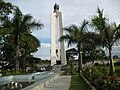 Kanglasha


,_installed_on_the_top_of_a_monumental_pillar,_dedicated_to_the_Meitei_martyrs_of_Kangleipak_(Manipur),_standing_inside_the_historic_Bir_Tikendrajit_Park,_Imphal.jpg)

.svg)

See also
[edit | edit source]References
[edit | edit source]
Wikimedia Commons has media related to Lua error in Module:Commons_link at line 62: attempt to index field 'wikibase' (a nil value)..
- ^ a b Moirangthem Kirti (1993). Folk Culture of Manipur. Manas Publications. ISBN 978-81-7049-063-0.
- ^ Lua error in Module:Citation/CS1/Configuration at line 2172: attempt to index field '?' (a nil value).
- ^ a b North East India History Association. Session (1990). Proceedings of North East India History Association. The Association.
- ^ Internationales Asien Forum: International quarterly for Asian studies. Weltform Verlag. 1989
- ^ Museum, Indian (1998). Bulletin - Indian Museum.
- ^ Bahadur, Mutua; Santabai, Y. (1989). Tribal Art of Manipur. Mutua Museum.
- ^ Mohd. Anis Md. Nor (2012). Dancing Mosaic: Issues on Dance Hybridity. Cultural Centre, University of Malaya. ISBN 978-967-03-8017-9.
- ^ 'Story of a Giant Poubi lai' show begins on Jan 7
- ^ Manipur's Loch Ness monster and other folktales at Wari-Jalsa storytelling fest - The Week
- ^ Lua error in Module:Citation/CS1/Configuration at line 2172: attempt to index field '?' (a nil value).
- ^ Wahengbam Ibohal (1986). The History of Manipur: An early period. Manipur Commercial Company.
- ^ Lua error in Module:Citation/CS1/Configuration at line 2172: attempt to index field '?' (a nil value).
