Lubart's Castle
 | This article needs additional citations for verification. (June 2024) |
| Lutsk Castle | |
|---|---|
| Lutsk, Ukraine | |
 Lubart Tower – main gate of the Lutsk Castle | |
| Site information | |
| Type | Castle |
| Location | |
| Lua error in Module:Location_map at line 411: Malformed coordinates value. | |
| Lua error in Module:Infobox_mapframe at line 197: attempt to index field 'wikibase' (a nil value). | |
| Coordinates | Lua error: callParserFunction: function "#coordinates" was not found. |
| Site history | |
| Built | 14th century |
| Built by | Liubartas |
| Designations | |
| Official name | Замок (Castle) |
| Type | Architecture |
| Reference no. | 030106 |
Lutsk Castle (Ukrainian: Луцький замок, romanized: Lutskyi zamok; Polish: Zamek w Łucku), also locally known as Liubart's Castle (Lithuanian: Liubarto pilis; Ukrainian: Замок Любарта, romanized: Zamok Liubarta) or Upper Castle (Lithuanian: Lucko aukštutinė pilis; Ukrainian: Верхній замок, romanized: Verkhnii zamok), began its life in the mid-14th century as the fortified seat of Gediminas' son Liubartas (Lubart), the last ruler of united Galicia-Volhynia. It is the most prominent landmark of Lutsk, Ukraine and as such appears on the 200 hryvnia bill. (Another city castle, called Lower Castle, built by the Czartoryski family since the 14th century, is now a ruin).
History
[edit | edit source]The Kievan Rus' town of Luchesk had a wooden wall as early as 1075, when Boleslaus the Bold laid siege to it for six months. Yury Dolgoruky failed to take Lutsk after a six-weeks siege in 1149. In 1255, the walls of Lutsk were stormed by Khan Jochi's grandson Kuremsa.[1]
The current castle, towering over the Styr River, was built mostly in the 1340s, although some parts of the earlier walls were used. It repelled sieges by numerous potentates, including Casimir the Great (1349), Jogaila (1431), and Sigismund Kęstutaitis (1436). In addition to the Lithuanian nobles gathered there with the Supreme Duke of Lithuania Władysław II Jagiełło and the Grand Duke Vytautas, the Congress was attended by the Holy Roman Emperor Sigismund; the Grand Prince of Moscow Vasily II; and the Voivode Dan II of Wallachia.[2]
During the long reign of Vytautas, Lutsk Castle was further fortified to guard against artillery and gunfire. The principal entrance, now bricked in, was from the west and adjoined a bridge over outer moat. Three main towers, now named "Lubart", "Švitrigaila" (both after Lithuanian princes) and the "Bishop", were built up in the course of the 16th and 17th centuries.
The walls of the castle formerly enclosed St. John's Cathedral, a palace of the grand dukes, and an episcopal palace. Of these buildings, only the Neoclassical palace of the bishops still stands.
On 2 July 1941 1,160 Jews were murdered within the walls of the castle.[3] There is no monument or marker for this tragedy in the castle.
-
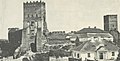 View of the castle circa 1916
 -
 The castle tower on the reverse of 200 hryvnias banknote


References
[edit | edit source]- ^ Lua error in Module:Citation/CS1/Configuration at line 2172: attempt to index field '?' (a nil value).
- ^ Lua error in Module:Citation/CS1/Configuration at line 2172: attempt to index field '?' (a nil value).
- ^ Timothy Snyder: The Life and Death of Western Volhynian Jewry, 1921-1945. In: Ray Brandon, Wendy Lower: The Shoah in Ukraine. Indiana University Press, 2008, Lua error in Module:Citation/CS1/Configuration at line 2172: attempt to index field '?' (a nil value)., Lua error in Module:Citation/CS1/Configuration at line 2172: attempt to index field '?' (a nil value)., S. 92
- Памятники градостроительства и архитектуры Украинской ССР. Киев: Будивельник, 1983—1986. Том 2, с. 48.
External links
[edit | edit source]- Walk around Lutsk Castle (video)
- Error creating thumbnail: File missing Media related to Lua error in Module:Commons_link at line 62: attempt to index field 'wikibase' (a nil value). at Wikimedia Commons

Lua error in Module:Coordinates at line 489: attempt to index field 'wikibase' (a nil value).
 Black Ruthenia Black Ruthenia |
| ||||
|---|---|---|---|---|---|
 Volhynia Volhynia |
| ||||
| File:POL województwo ruskie COA.svg Red Ruthenia |
| ||||
| File:COA Podolian Voivodeship IRP Lob.svg Podolia |
| ||||
| Wild Fields |
| ||||


