Julius Hübner
 | You can help expand this article with text translated from [[:de:Lua error in Module:WikidataIB at line 482: attempt to index field 'wikibase' (a nil value).|the corresponding article]] in Deutsch. (October 2016) Click [show] for important translation instructions.
|

Julius Hübner (27 January 1806 – 7 November 1882) was a German historical painter of the Düsseldorf school of painting. He was also known as a poet and the father of Emil Hübner, a distinguished classical scholar.
Life
[edit | edit source]Hübner was born at Oels in Silesia, studied at the Prussian Academy of Arts in Berlin under Schadow, and in Düsseldorf. He first attracted attention by his picture of "Ruth and Boaz" (1825). He traveled in Italy and resided for the most part at Düsseldorf until 1839. In that year he settled at Dresden, becoming a professor in the Academy of Arts in 1841 and director of the Gallery of Paintings in 1871. He obtained the great gold medal at Brussels in 1851. He died in Loschwitz.
Works
[edit | edit source]Among the works of Hübner's first period are The Fisherman (1828), after Goethe's ballad; Ruth and Naomi (1833), in the National Gallery, Berlin; Christ and the Four Evangelists (1835); Job and his Friends (1838), in the Gallery of Frankfurt; Consider the Lilies (1839); and the portrait of Frederick III, in Frankfurt's Römer.
To his second, or Dresden, period belong the Golden Age and Dispute between Luther and Dr. Eck (1866), in the Dresden Gallery; Charles V at San Yuste; Last Days of Frederick the Great; Cupid in Winter, and others.
Gallery
[edit | edit source]-
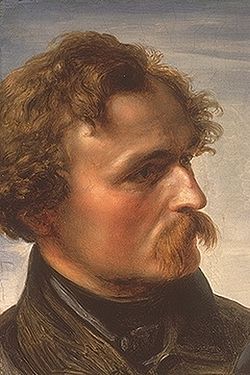 Carl Friedrich Lessing (detail)
 -

-

-


References
[edit | edit source]- This article incorporates text from a publication now in the public domain: Lua error in Module:Citation/CS1/Configuration at line 2172: attempt to index field '?' (a nil value).
External links
[edit | edit source]
- Leben und Werk des Malers (in German)
Lua error in Module:Authority_control at line 153: attempt to index field 'wikibase' (a nil value).