Horizontal integration facility
(Redirected from Horizontal Integration Facility)
The examples and perspective in this article deal primarily with the United States and do not represent a worldwide view of the subject. (June 2020) |

A horizontal integration facility (HIF) is an integration facility where missiles and rockets are assembled before launch.
HIF in the United States
[edit | edit source]| Site | Pad | Vehicle | Coordinates | Description | Images | Ref. |
|---|---|---|---|---|---|---|
| Cape Canaveral Space Force Station | SLC-37 | Delta IV | Lua error: callParserFunction: function "#coordinates" was not found. | A seven-story white building containing 2 bays measuring 250 feet (76 m) by 100 feet (30 m) each. Construction was completed in June 2000. Its floors are said to be the most level in the United States, varying less than 0.38 in (9.6 mm) across each bay. The first and second stages of the rocket, along with any boosters that are being used for that flight, are integrated in the HIF, and then the stack is moved to the pad and raised to vertical. The payload and fairing are assembled later. | File:Two Boeing Delta IV first stages on the Launch Complex 37, Cap Canaveral Air Force Station, August 2004.jpg | [1][2] |
| Cape Canaveral Space Force Station | SLC-40 | Falcon 9 | Lua error: callParserFunction: function "#coordinates" was not found. | SpaceX built its first Falcon 9 HIF on the south side of the pad. It measures 225 feet (69 m) long by 75 feet (23 m) wide and stands about 50 feet (15 m) tall. A former payload integration facility is directly adjacent to the HIF. The HIF was extended to a length of at least 72 metres to accommodate the longer versions of the Falcon 9. | File:Falcon 9 in SLC-40 hangar before roll-out - CRS-2 (KSC-2013-1676).jpg | [3][4] |
| Kennedy Space Center | LC-39A | Falcon 9 / Falcon Heavy | Lua error: callParserFunction: function "#coordinates" was not found. | SpaceX built its second HIF on the Crawlerway leading to the Launch Complex 39A just outside of its perimeter. It can accommodate both Falcon 9 and Falcon Heavy. It is able to support 5 boosters side by side. Inside the HIF the Falcon 9 / Falcon Heavy rockets are assembled and the payload, encapsulated in the fairing is connected to the rocket. | File:SpaceX HIF at KSC LC-39A (27550168066).jpg | |
| Kwajalein Atoll | Omelek Island | Falcon 1 | Lua error: callParserFunction: function "#coordinates" was not found. | A HIF has been built by SpaceX. | Exterior Interior | [5] |
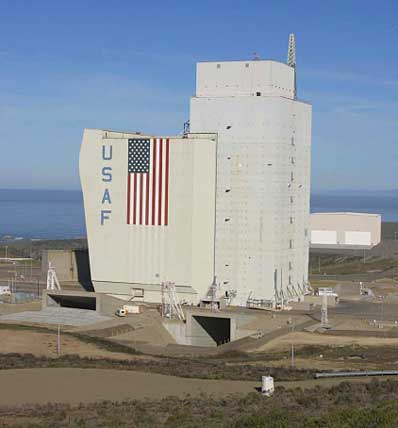
| Vandenberg Air Force Base | SLC-6 | Delta IV | Lua error: callParserFunction: function "#coordinates" was not found. | A "cavernous"[6] HIF exists. The HIF contains two bays that can accommodate the Delta IV and Delta IV Heavy. | Exterior | [6] |
| Wallops Flight Facility | Antares | Lua error: callParserFunction: function "#coordinates" was not found.[7] | HIF built by Orbital Sciences Corporation. The HIF is 250 feet (76 m) long by 150 feet (46 m) wide by 60 feet (18 m) tall.[8] It opened in 2011. | File:Antares A-ONE rollout 01.jpg | [9] |

.jpg)
.jpg)



HIF elsewhere
[edit | edit source]Most Russian, Ukrainian and former Soviet launchers are integrated horizontally, including Dnepr, Proton, Rockot, Shtil' and Soyuz. The Electron launch vehicle is also integrated horizontally and European Ariane 6 also uses HIF to integrate its rocket stack.
References
[edit | edit source]- ^ Heavy-lifting Delta 4 rocket to take test flight, Spaceflight Now, Justin Ray, 2003-11-19.
- ^ Complex 37, GlobalSecurity.org, John Pike, 2005-01-06.
- ^ Lua error in Module:Citation/CS1/Configuration at line 2172: attempt to index field '?' (a nil value).
- ^ Space Launch Report: SpaceX Falcon Data Sheet, Ed Kyle, 2008-12-02.
- ^ Falcon 1 Users Guide (Revision 7) Archived 2012-02-22 at the Wayback Machine, SpaceX, 2008-05-15, page 35.
- ^ a b Launch Facility Profile: Vandenberg Air Force Base Archived 2012-05-16 at the Wayback Machine, The Aerospace Corporation, 2006-02-17.
- ^ Taurus II Development News, NASASpaceFlight.com Forums, Reply #7, Antonioe, 2009-01-09.
- ^ Lua error in Module:Citation/CS1/Configuration at line 2172: attempt to index field '?' (a nil value).
- ^ Development Status of a Medium-Class Launch Vehicle for ISS Cargo and Satellite Delivery Archived 2011-06-16 at the Wayback Machine, David Steffy, Orbital Sciences Corporation, 2008-07-15, page 9.