Hlyboka
Hlyboka
Глибока Hliboka • Adâncata | |
|---|---|
| Traditional Folk Architecture Traditional Folk Architecture | |
|
Flag of Hlyboka Flag Coat of arms of Hlyboka Coat of arms | |
| Lua error in Module:Infobox_mapframe at line 197: attempt to index field 'wikibase' (a nil value). | |
| Lua error in Module:Location_map at line 411: Malformed coordinates value. | |
| Coordinates: Lua error in Module:Coordinates at line 489: attempt to index field 'wikibase' (a nil value). | |
| Country | Ukraine |
| Oblast | Chernivtsi Oblast |
| Raion | Chernivtsi Raion |
| Established | 1438 |
| Urban Status | 1956 |
| Government | |
| • Mayor | Hryhoriy Vanzuryak |
| Area | |
• Total | 7.22 km2 (2.79 sq mi) |
| Elevation | 345 m (1,132 ft) |
| Population (2022)[1] | |
• Total | 9,226 |
| • Density | 1,280/km2 (3,310/sq mi) |
| Time zone | UTC+2 (EET) |
| • Summer (DST) | UTC+3 (EEST) |
| Postal code | 60400—60406 |
| Area code | +380 3734 |
Hlyboka (Ukrainian: Глибока; German and Polish: Hliboka; Romanian: Adâncata) is a rural settlement in Chernivtsi Raion, Chernivtsi Oblast, western Ukraine. It hosts the administration of Hlyboka settlement hromada, one of the hromadas of Ukraine.[2] Population: 9,226 (2022 estimate).[1]
History
[edit | edit source]Hlyboka is mentioned for the first time in 1438.
Before World War II, large parts of Hlyboka's land were owned by Polish noble families: until 1892, Prince Adam Sapieha, then Bronislaw Skibniewski (1830–1904), and later by his son Aleksander Skibniewski (1868–1942).
Hlyboka received urban-type settlement status in 1956.[3]
Until 18 July 2020, Hlyboka served as the administrative center of Hlyboka Raion. The raion was abolished in July 2020 as part of the administrative reform of Ukraine, which reduced the number of raions of Chernivtsi Oblast to three. The area of Hlyboka Raion was merged into Chernivtsi Raion.[4][5]
On 26 January 2024, a new law entered into force, abolishing the status of urban-type settlement in Ukraine, and Hlyboka became a rural settlement.[6]
Demographics
[edit | edit source]In 2001, 84.64% of the 9,124 inhabitants spoke Ukrainian as their native language (7,723 people), while 12.16% spoke Romanian, or 1,109 people (11.72% called it Romanian, or 1069 people, and 0.44% called it "Moldovan", or 40 people), and 2.97% spoke Russian, or 271 people.[7] In 1989, out of a population of mostly Ukrainian 9,352 inhabitants, 1,698 declared that they were ethnic Romanians (18.86%) and 183 declared that they were ethnic Moldovans (1.96%).[8] Most of the population with a Moldovan identity switched their declared census identities from Moldovan and Moldovan-speaking to Romanian and Romanian-speaking between the 1989 and 2001 censuses.[9] In 1992-1993, in the two Ukrainian-language schools in the locality, there were 1,493 students; out of them, 264 had a Romanian ethnic identity (17.68%) and 14 had a Moldovan ethnic identity (0.94%).[10]
According to the 2001 Ukrainian census, in the Hlyboka settlement community, which was created in 2020 and had a population of 18,897 according to the census, and whose capital was Hlyboka, 70.39% of the inhabitants spoke Ukrainian as their native language, or 13,301 people, while 27.48%, or 5,193 people, spoke Romanian (including 5,117 who called it Romanian, or 27.08%, and 76 called it "Moldovan", or 0.4%), and 1.91%, or 271 people, spoke Russian.[11]
International relations
[edit | edit source]Twin towns - sister cities
[edit | edit source]Hlyboka is twinned with:
- Piatra Neamț, Romania[12]
Notable people
[edit | edit source]- Valerii Krasnian (1971–2022), Ukrainian volunteer, cyborg, and serviceman who was one of the symbols of the fight for Donetsk airport.
Hlyboka on old photographs
[edit | edit source]-
 Skibniewski Palace in 1925
 -
 Front
Front -
Front
-
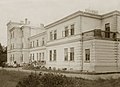 View from the gardens
 -
Fragment


References
[edit | edit source]- Notes
- ^ a b Lua error in Module:Citation/CS1/Configuration at line 2172: attempt to index field '?' (a nil value).
- ^ Lua error in Module:Citation/CS1/Configuration at line 2172: attempt to index field '?' (a nil value).
- ^ Lua error in Module:Citation/CS1/Configuration at line 2172: attempt to index field '?' (a nil value).
- ^ Lua error in Module:Citation/CS1/Configuration at line 2172: attempt to index field '?' (a nil value).
- ^ Lua error in Module:Citation/CS1/Configuration at line 2172: attempt to index field '?' (a nil value).
- ^ Lua error in Module:Citation/CS1/Configuration at line 2172: attempt to index field '?' (a nil value).
- ^ The Ukrainian census of 2001, language data by localities, at https://socialdata.org.ua/projects/mova-2001/
- ^ Ion Popescu and Constantin Ungureanu, Romanii din Ucraina - intre trecut si viitor, vol. 1 (Romanii din Regiunea Cernauti), Cernauti, 2005, p. 212.
- ^ Ion Popescu and Constantin Ungureanu, Romanii din Ucraina - intre trecut si viitor, vol. 1 (Romanii din Regiunea Cernauti), Cernauti, 2005, p. 257.
- ^ Ion Popescu and Constantin Ungureanu, Romanii din Ucraina - intre trecut si viitor, vol. 1 (Romanii din Regiunea Cernauti), Cernauti, 2005, p. 262.
- ^ See the 2001 Ukrainian census results by language by locality at https://socialdata.org.ua/projects/mova-2001/. The reason why the term "Moldovan language" appears within quotation marks is because this is how this is written on this official statistical website of the Republic of Moldova. See Lua error in Module:Citation/CS1/Configuration at line 2172: attempt to index field '?' (a nil value).
- ^ Lua error in Module:Citation/CS1/Configuration at line 2172: attempt to index field '?' (a nil value).
External links
[edit | edit source]Error creating thumbnail: File missing Media related to Lua error in Module:Commons_link at line 62: attempt to index field 'wikibase' (a nil value). at Wikimedia Commons


Lua error in Module:Authority_control at line 153: attempt to index field 'wikibase' (a nil value).