Pinus sabiniana
| Pinus sabiniana | |
|---|---|
| File:Pinus sabiniana.jpg | |
| Scientific classification Edit this classification | |
| Kingdom: | Plantae |
| Clade: | Tracheophytes |
| Clade: | Gymnospermae |
| Division: | Pinophyta |
| Class: | Pinopsida |
| Order: | Pinales |
| Family: | Pinaceae |
| Genus: | Pinus |
| Subgenus: | P. subg. Pinus |
| Section: | P. sect. Trifoliae |
| Subsection: | P. subsect. Ponderosae |
| Species: | P. sabiniana
|
| Binomial name | |
| Pinus sabiniana | |
| File:Pinus sabiniana distribution map.svg | |
Pinus sabiniana (sometimes spelled P. sabineana) is a pine endemic to California in the United States.[2][3] Its vernacular names include towani pine, foothill pine, gray pine, ghost pine, and bull pine. The name digger pine was historically used but includes a racial slur.[4][5][6][7][8]
Description
[edit | edit source]Pinus sabiniana trees typically grow to 11–14 metres (36–45 ft), but can reach 32 m (105 ft). The pine needles are in fascicles (bundles) of three, distinctively pale gray-green, sparse and drooping, and grow to 20–30 centimetres (8–12 in) in length. The seed cones are large and heavy, 12–35 cm (4+3⁄4–13+3⁄4 inches) in length and almost as wide as they are long.[7][5][9] When fresh, they weigh from 0.3 to 0.7 kilograms (0.7 to 1.5 lb), rarely over 1 kg (2.2 lb).[10] The male cones grow at the base of shoots on the lower branches.[7][5][9]
-
 Bark
Bark -
 Foliage
 -
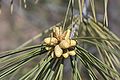 Pollen cones
 -
 Cone, seeds, and resin

_-_foliage_(30485878313).jpg)

.jpg)


Taxonomy
[edit | edit source]
Common name
[edit | edit source]The name digger pine supposedly came from the observation that the Paiute foraged for its seeds by digging around the base of the tree. It is more likely that the term was first applied to the people; "Digger Indians" was in common use in California literature from the 1800s. The historically more common name digger pine is still in widespread use. The Jepson Manual advises avoiding this name as the authors believe "digger" is pejorative in origin.[11][12][13]
The tree is also sometimes thought of as a pinyon pine, though it does not belong to that group.
| Language | Name |
|---|---|
| Achumawi | tujhalo |
| Awaswas Ohlone | hireeni (pine tree); saak (pinenut) |
| Chalon Ohlone | šaak (pinenut) |
| Chimariko | hatcho |
| Chochenyo Ohlone | saak (pinenut) |
| Chukchansi Yokuts | ton' (pinenut); shaaxal' (pine sap) |
| Karuk | axyúsip |
| Klamath | gapga [14] |
| Konkow | tä-nē' [15] |
| Maidu | towáni |
| Mono | tunah |
| Mutsun Ohlone | hireeni; saak (pinenut) |
| Patwin | tuwa; sanank (pinenut) |
| Rumsen Ohlone | xirren |
| Southern Sierra Miwok | sakky |
| Wappo | náyo |
| Wintu | xisi (unripe pinenut); chati (ripe pinenut) |
| Yana | c'ala'i [14] |
Botanical name
[edit | edit source]The scientific botanical name with the standard spelling sabiniana commemorates Joseph Sabine, secretary of the Horticultural Society of London. Some botanists proposed a new spelling sabineana, because they were confused with Latin grammar. The proposal has not been accepted by the relevant authorities (i.e. United States Department of Agriculture, The Jepson Manual or Germplasm Resources Information Network (GRIN).[4][5][7][16] The GRIN notes that the spelling sabiniana agrees with a provision in the Vienna Code of the International Code of Botanical Nomenclature, the governing body of botanical nomenclature. In that code, recommendation 60.2C states that personal names can be Latinized in species epithets: 'Sabine' is Latinised to sabinius, with the addition of the suffix "-anus" (pertaining to) the word becomes sabiniana (In Latin, trees are feminine, irrespective if the word ends with a masculine suffix, i.e. pinus).[16][17] The GRIN database notes that Sabine's last name is not correctable and therefore Pinus sabiniana is the proper name for the species.
Distribution and habitat
[edit | edit source]

Pinus sabiniana grows at elevations between sea level and 1,200 m (4,000 ft) and is common in the northern and interior portions of the California Floristic Province. It is found throughout the Sierra Nevada and Coast Ranges foothills that ring the Central, San Joaquin and interior valleys; the Transverse and Peninsular Ranges; and Mojave Desert sky islands.[5][9] Multiple specimens have also been found in Southern Oregon as well.[18][19] It is adapted to long, hot, dry summers and is found in areas with an unusually wide range of precipitation: from an average of 250 mm (10 in) per year at the edge of the Mojave to 1,780 mm (70 in) in parts of the Sierra Nevada.[10] It prefers rocky, well drained soil, but also grows in serpentine soil and heavy, poorly drained clay soils. It commonly occurs in association with Quercus douglasii,[20] and "Oak/Foothill Pine vegetation" (also known as "Oak/Gray Pine vegetation") is used as a description of a type of habitat characteristic within the California chaparral and woodlands ecoregion in California, providing a sparse overstory above a canopy of the oak woodland.
Ecology
[edit | edit source]Pinus sabiniana needles are a food of the caterpillars of the Gelechiid moth Chionodes sabinianus. Fossil evidence suggests that it has only recently become adapted to the Mediterranean climate as its closest relatives are part of the Madrean pine-oak woodlands found at higher elevations in the southwest US and Mexico.[21]
Animals help spread the seeds, including birds such as the scrub jay and acorn woodpecker.[22]
Uses
[edit | edit source]Some Native American groups relied heavily on sweet pine nuts for food[23] and are thought to have contributed to the current distribution pattern, including the large gap in distribution in Tulare County. Native Americans also consumed the roots.[24]
Protein and fat nutritional value of the seed are similar to Pinus pinea seeds and figured in the local indigenous diet.[25]
Wood uses historically were determined by its particular characteristics, e.g., 0.43 mean specific gravity nearly equal to Douglas-fir (Pseudotsuga menziesii); strength properties similar to ponderosa pine; Kraft pulps high in bursting with tensile strength comparable to some northern conifer pulps; and foothill stands loggable in winter, when higher-altitude species were inaccessible. However, the high amounts of resin and compression wood, the often crooked form, heavy weight, and low stand density, made it expensive otherwise to log, transport and process. Commercial value decreased by the 1960s,[25] to limited use for railroad ties, box "shook",[26] pallet stock, and chips.
It may still offer potential as windbreak shelterbelt plantings.[25]
The main turpentine constituent, heptane, an alkane hydrocarbon, at about 3 percent of needle and twig oil,[25] is unusual in botany; the only other source in nature perhaps being the Pittosporum resiniferum, known as "petroleum nut" or kerosene tree.
Notes
[edit | edit source]- ^ Lua error in Module:Citation/CS1/Configuration at line 2172: attempt to index field '?' (a nil value).
- ^ Cole 1939.
- ^ Beissner 1909.
- ^ a b Lua error in Module:Citation/CS1/Configuration at line 2172: attempt to index field '?' (a nil value).
- ^ a b c d e Lua error in Module:Citation/CS1/Configuration at line 2172: attempt to index field '?' (a nil value).
- ^ Lua error in Module:Citation/CS1/Configuration at line 2172: attempt to index field '?' (a nil value).
- ^ a b c d Lua error in Module:Citation/CS1/Configuration at line 2172: attempt to index field '?' (a nil value).
- ^ Lua error in Module:Citation/CS1/Configuration at line 2172: attempt to index field '?' (a nil value).
- ^ a b c Lua error in Module:Citation/CS1/Configuration at line 2172: attempt to index field '?' (a nil value).
- ^ a b Lua error in Module:Citation/CS1/Configuration at line 2172: attempt to index field '?' (a nil value).
- ^ Hickman, J.C. (Ed.) "The Jepson Manual, Higher Plants of California". University of California Press, Berkeley, 1993 p.120.
- ^ Lua error in Module:Citation/CS1/Configuration at line 2172: attempt to index field '?' (a nil value).
- ^ Lua error in Module:Citation/CS1/Configuration at line 2172: attempt to index field '?' (a nil value).
- ^ a b Lua error in Module:Citation/CS1/Configuration at line 2172: attempt to index field '?' (a nil value).
- ^ Lua error in Module:Citation/CS1/Configuration at line 2172: attempt to index field '?' (a nil value).
- ^ a b Lua error in Module:Citation/CS1/Configuration at line 2172: attempt to index field '?' (a nil value).
- ^ International Code of Botanical Nomenclature. 2006. Recommendation 60C.2 Archived 26 January 2021 at the Wayback Machine. Accessed online: 1 October 2010.
- ^ Lua error in Module:Citation/CS1/Configuration at line 2172: attempt to index field '?' (a nil value).
- ^ Lua error in Module:Citation/CS1/Configuration at line 2172: attempt to index field '?' (a nil value).
- ^ Hogan 2008.
- ^ Munz, P. "A California Flora and supplement" University of California Press
- ^ Lua error in Module:Citation/CS1/Configuration at line 2172: attempt to index field '?' (a nil value).
- ^ Lua error in Module:Citation/CS1/Configuration at line 2172: attempt to index field '?' (a nil value).
- ^ Lua error in Module:Citation/CS1/Configuration at line 2172: attempt to index field '?' (a nil value).
- ^ a b c d Lua error in Module:Citation/CS1/Configuration at line 2172: attempt to index field '?' (a nil value).
 This article incorporates text from this source, which is in the public domain.
- ^ Lua error in Module:Citation/CS1/Configuration at line 2172: attempt to index field '?' (a nil value).
References
[edit | edit source]- Lua error in Module:Citation/CS1/Configuration at line 2172: attempt to index field '?' (a nil value).
- A. Farjon (2005). Pines: Drawings and descriptions of the genus Pinus. Brill. Lua error in Module:Citation/CS1/Configuration at line 2172: attempt to index field '?' (a nil value).
- Lua error in Module:Citation/CS1/Configuration at line 2172: attempt to index field '?' (a nil value).
- Discovery Channel (2010), MythBusters, Episode 138[dead link]
- Lua error in Module:Citation/CS1/Configuration at line 2172: attempt to index field '?' (a nil value).
- Lua error in Module:Citation/CS1/Configuration at line 2172: attempt to index field '?' (a nil value).
Further reading
[edit | edit source]- Lua error in Module:Citation/CS1/Configuration at line 2172: attempt to index field '?' (a nil value).
External links
[edit | edit source]- Error creating thumbnail: File missing Media related to Lua error in Module:Commons_link at line 62: attempt to index field 'wikibase' (a nil value). at Wikimedia Commons
- File:Wikispecies-logo.svg Data related to Pinus sabiniana at Wikispecies
- Jepson eFlora, The Jepson Herbarium, University of California, Berkeley
- USDA PLANTS Treatment for Pinus sabiniana (California foothill pine)
- Pinus sabiniana in the CalPhotos photo database, University of California, Berkeley


Lua error in Module:Taxonbar at line 165: attempt to index field 'wikibase' (a nil value). Lua error in Module:Authority_control at line 153: attempt to index field 'wikibase' (a nil value).
- IUCN Red List least concern species
- Pinus
- Endemic flora of California
- Trees of Northern America
- Flora of the Sierra Nevada (United States)
- Flora of the California desert regions
- Natural history of the California chaparral and woodlands
- Garden plants of North America
- Ornamental trees
- Drought-tolerant trees
- Butterfly food plants
- Edible nuts and seeds