Arrector pili muscle
| Details | |
|---|---|
| Nerve | Sympathetic postganglionic nerve fibers |
| Identifiers | |
| TA98 | Lua error in Module:Wikidata at line 746: attempt to index field 'wikibase' (a nil value). |
| TH | {{#property:P1694}} |
| TE | {{#property:P1693}} |
| FMA | {{#property:P1402}} |
| Anatomical terms of muscle [[[d:Lua error in Module:Wikidata at line 865: attempt to index field 'wikibase' (a nil value).|edit on Wikidata]]] | |
The arrector pili muscles, also known as hair erector muscles,[1] are small muscles attached to hair follicles in mammals. Contraction of these muscles causes the hairs to stand on end,[2] known colloquially as goose bumps (piloerection).[3]
Structure
[edit | edit source]Each arrector pili is composed of a bundle of smooth muscle fibres which attach to several follicles (a follicular unit).[4] Each is innervated by the sympathetic division of the autonomic nervous system.[4] The muscle attaches to the follicular stem cell niche in the follicular bulge,[3][4][5] splitting at their deep end to encircle the follicle.[6]
Function
[edit | edit source]The contraction of the muscle is involuntary. Stresses such as cold, fear etc. may stimulate the sympathetic nervous system, and thus cause muscle contraction.[4]
Thermal insulation
[edit | edit source]Contraction of arrector pili muscles have a principal function in the majority of mammals of providing thermal insulation.[4] Air becomes trapped between the erect hairs, helping the animal retain heat.
Self defence
[edit | edit source]Many animals experience contraction of the arrector pili muscle in response to a perceived threat. This helps the animal seem larger and more intimidating as a result.[7]
Sebum excretion
[edit | edit source]Pressure exerted by the muscle may cause sebum to be forced along the hair follicle towards the surface, protecting the hair.[8]
Hair follicle stability
[edit | edit source]Arrector pili muscles also stabilise the base of the hair follicle.[5][6]
Clinical significance
[edit | edit source]Skin conditions such as leprosy can damage arrector pili muscles, preventing their contraction.[9] Inducing contraction of the arrector pili muscles via an α1-adrenergic receptor agonist has been shown to reduce hair shedding as a result of traction alopecia.[10]
History
[edit | edit source]The term "arrector pili" comes from Latin. It translates to "hair erector".[1]
Additional images
[edit | edit source]-
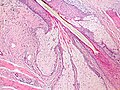 Insertion of sebaceous glands into hair shaft
 -
 Cross-section of all skin layers


Notes
[edit | edit source]- ^ a b Lua error in Module:Citation/CS1/Configuration at line 2172: attempt to index field '?' (a nil value).
- ^ Lua error in Module:Citation/CS1/Configuration at line 2172: attempt to index field '?' (a nil value).
- ^ a b Lua error in Module:Citation/CS1/Configuration at line 2172: attempt to index field '?' (a nil value).
- ^ a b c d e Lua error in Module:Citation/CS1/Configuration at line 2172: attempt to index field '?' (a nil value).
- ^ a b Lua error in Module:Citation/CS1/Configuration at line 2172: attempt to index field '?' (a nil value).
- ^ a b Lua error in Module:Citation/CS1/Configuration at line 2172: attempt to index field '?' (a nil value).
- ^ Lua error in Module:Citation/CS1/Configuration at line 2172: attempt to index field '?' (a nil value).
- ^ Lua error in Module:Citation/CS1/Configuration at line 2172: attempt to index field '?' (a nil value).
- ^ Lua error in Module:Citation/CS1/Configuration at line 2172: attempt to index field '?' (a nil value).
- ^ Lua error in Module:Citation/CS1/Configuration at line 2172: attempt to index field '?' (a nil value).
References
[edit | edit source]- Myers, P., R. Espinosa, C. S. Parr, T. Jones, G. S. Hammond, and T. A. Dewey. 2006. The Animal Diversity Web; https://web.archive.org/web/20110903154915/http://animaldiversity.ummz.umich.edu/site/topics/mammal_anatomy/hair.html
- Lua error in Module:Citation/CS1/Configuration at line 2172: attempt to index field '?' (a nil value).
Lua error in Module:Authority_control at line 153: attempt to index field 'wikibase' (a nil value).