Daggertooth pike conger
| Daggertooth pike conger | |
|---|---|
| File:Muraenesox cinereus - 1700-1880 - Print - Iconographia Zoologica - Special Collections University of Amsterdam - UBA01 IZ15200032.tif | |
| Scientific classification Edit this classification | |
| Kingdom: | Animalia |
| Phylum: | Chordata |
| Class: | Actinopterygii |
| Order: | Anguilliformes |
| Family: | Muraenesocidae |
| Genus: | Muraenesox |
| Species: | M. cinereus
|
| Binomial name | |
| Muraenesox cinereus | |
| Synonyms | |
|
Muraena cinerea Forsskål, 1775 | |
The daggertooth pike conger (Muraenesox cinereus) also known as the darkfin pike eel in Australia, to distinguish it from the related pike-eel (Muraenesox bagio),[3] is a species of eel in the pike conger family, Muraenesocidae.[4] They primarily live on soft bottoms in marine and brackish waters down to a depth of 800 m (2,600 ft), but may enter freshwater.[4] They commonly grow to about 1.5 m (4.9 ft) in length,[5] but may grow as long as 2.2 m (7.2 ft).[4] Daggertooth pike congers occur in the Red Sea, on the coast of the northern Indian Ocean, and in the West Pacific from Indochina to Japan. A single specimen was also reported in the Mediterranean Sea off Israel in 1982.[6]
Culinary uses
[edit | edit source]Daggertooth pike conger is a major commercial species, with annual catches reaching about 350,000 tonnes in recent years. The spot reporting the largest landings was Taiwan.[5] It is eaten in Japanese cuisine, where it is known as hamo (ハモ, 鱧).[7] In the Kansai Region, hamo no kawa (pickled conger skins) is a traditional delicacy,[citation needed] and pike conger is a common ingredient in some types of kamaboko (fish cake).[8][9] It is also frequently canned and exported to Asian markets.
Parasites
[edit | edit source]As with other fish, the daggertooth pike conger harbours several species of parasites.
A species of trichosomoidid nematode which parasitizes the muscles of the fish off Japan has been described in 2014 and named Huffmanela hamo, in reference to the Japanese name of the fish.[10] Accumulations of eggs of the parasite are visible as 1–2mm black spots in the flesh of the fish. The parasite is rare and the consumption of infected fish meat has no consequences for humans.
Gallery
[edit | edit source]-
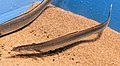 Specimen seen at Nagasaki Penguin Aquarium
 -
Illustration
-
Hamo with pickled plum
-
Eggs of Huffmanela hamo in muscles


_-_Kawahara_Keiga_-_1823_-_1829_-_Siebold_Collection_-_pencil_drawing_-_water_colour.jpeg)


References
[edit | edit source]- ^ Lua error in Module:Citation/CS1/Configuration at line 2172: attempt to index field '?' (a nil value).
- ^ Lua error in Module:Citation/CS1/Configuration at line 2172: attempt to index field '?' (a nil value).
- ^ Lua error in Module:Citation/CS1/Configuration at line 2172: attempt to index field '?' (a nil value).
- ^ a b c Lua error in Module:Citation/CS1/Configuration at line 2172: attempt to index field '?' (a nil value).
- ^ a b Lua error in Module:Citation/CS1/Configuration at line 2172: attempt to index field '?' (a nil value).
- ^ Atlas of Exotic Fishes in the Mediterranean Sea (Muraenesox cinereus). 2nd Edition. 2021. 366p. CIESM Publishers, Paris, Monaco.https://ciesm.org/atlas/fishes_2nd_edition/Muraenesox_cinereus.pdf
- ^ Lua error in Module:Citation/CS1/Configuration at line 2172: attempt to index field '?' (a nil value).
- ^ Lua error in Module:Citation/CS1/Configuration at line 2172: attempt to index field '?' (a nil value).
- ^ Lua error in Module:Citation/CS1/Configuration at line 2172: attempt to index field '?' (a nil value).
- ^ Justine, J.-L. & Iwaki, T. 2014: Huffmanela hamo sp. n. (Nematoda: Trichosomoididae: Huffmanelinae) from the dagger-tooth pike conger Muraenesox cinereus off Japan. Folia Parasitologica, 61, 267–271 Lua error in Module:Citation/CS1/Configuration at line 2172: attempt to index field '?' (a nil value). Free PDF Open access icon
- ^ Lua error in Module:Citation/CS1/Configuration at line 2172: attempt to index field '?' (a nil value).

External links
[edit | edit source]Lua error in Module:Taxonbar at line 165: attempt to index field 'wikibase' (a nil value).
.jpg)