Cyclopentane
| |||
| Names | |||
|---|---|---|---|
| Preferred IUPAC name
Cyclopentane | |||
| Other names
pentamethylene
| |||
| Identifiers | |||
3D model (JSmol)
|
|||
| ChEBI | |||
| ChemSpider | |||
| ECHA InfoCard | Lua error in Module:Wikidata at line 880: attempt to index field 'wikibase' (a nil value). Lua error in Module:Wikidata at line 880: attempt to index field 'wikibase' (a nil value).Lua error in Module:EditAtWikidata at line 29: attempt to index field 'wikibase' (a nil value). | ||
| EC Number |
| ||
| E number | Lua error in Module:Wikidata at line 880: attempt to index field 'wikibase' (a nil value). | ||
PubChem CID
|
|||
| RTECS number |
| ||
| UNII | |||
CompTox Dashboard (EPA)
|
| ||
| |||
| |||
| Properties | |||
| C5H10 | |||
| Molar mass | 70.1 g/mol | ||
| Appearance | clear, colorless liquid | ||
| Odor | mild, sweet | ||
| Density | 0.751 g/cm3 | ||
| Melting point | −93.9 °C (−137.0 °F; 179.2 K) | ||
| Boiling point | 49.2 °C (120.6 °F; 322.3 K) | ||
| 156 mg·l−1 (25 °C)[1] | |||
| Solubility | soluble in ethanol, acetone, ether | ||
| Vapor pressure | 45 kPa (20 °C) [2] | ||
| Acidity (pKa) | ~45 | ||
| −59.18·10−6 cm3/mol | |||
Refractive index (nD)
|
1.4065 | ||
| Hazards | |||
| Occupational safety and health (OHS/OSH): | |||
Main hazards
|
Flammable[3] | ||
| NFPA 704 (fire diamond) | |||
| Flash point | −37.2 °C (−35.0 °F; 236.0 K) | ||
| 361 °C (682 °F; 634 K) | |||
| Explosive limits | 1.1%–8.7%[3] | ||
| NIOSH (US health exposure limits): | |||
PEL (Permissible)
|
none[3] | ||
REL (Recommended)
|
TWA 600 ppm (1720 mg/m3)[3] | ||
IDLH (Immediate danger)
|
N.D.[3] | ||
| Related compounds | |||
Related compounds
|
cyclopropane, cyclobutane, cyclohexane | ||
Except where otherwise noted, data are given for materials in their standard state (at 25 °C [77 °F], 100 kPa).
| |||


Cyclopentane (also called C pentane)[4] is a highly flammable alicyclic hydrocarbon with chemical formula C5H10 and CAS number 287-92-3, consisting of a ring of five carbon atoms each bonded with two hydrogen atoms above and below the plane. It is a colorless liquid with a petrol-like odor. Its freezing point is −94 °C and its boiling point is 49 °C. Cyclopentane is in the class of cycloalkanes, being alkanes that have one or more carbon rings. It is formed by cracking cyclohexane in the presence of alumina at a high temperature and pressure.
It was first prepared in 1893 by the German chemist Johannes Wislicenus.[5]
Production, occurrence and use
[edit | edit source]Cycloalkanes are formed by catalytic reforming. For example, when passed over a hot platinum surface, 2-methylbutane converts into cyclopentane.

Cyclopentane is principally used as a blowing agent in the manufacture of polyurethane insulating foam, replacing ozone-depleting agents such as CFC-11 and HCFC-141b.[6][7] While cyclopentane is not typically used as a refrigerant, it is common for domestic appliances that are insulated with cyclopentane-based foam, such as refrigerators and freezers, to be marked with cyclopentane warning labels due to its flammability. Cyclopentane is also used in the manufacture of synthetic resins and rubber adhesives.[citation needed]
Cyclopentane is a minor component of automobile fuel, with its share in US gasoline varying between 0.2 and 1.6% in early 1990s[8] and 0.1 to 1.7% in 2011.[9] Its research and motor octane numbers are reported as 101 or 103 and 85 or 86 respectively.[10][11]
Multiple alkylated cyclopentane (MAC) lubricants, such as 1,3,4-tri-(2-octyldodecyl) cyclopentane, have low volatility and are used by NASA in space applications.[12][13]
Cyclopentane requires safety precautions to prevent leakage and ignition as it is both highly flammable and can also cause respiratory arrest when inhaled.[14]
Cyclopentane can be fluorinated to give compounds ranging from C5H9F to perfluorocyclopentane C5F10. Such species are conceivable refrigerants and specialty solvents.[15][16]
The cyclopentane ring is pervasive in natural products including many useful drugs. Examples include most steroids, prostaglandins, and some lipids.
Conformations
[edit | edit source]In a regular pentagon, the angles at the vertices are all 108°, slightly less than the bond angle in perfectly tetrahedrally bonded carbon, which is about 109.47°. However, cyclopentane is not planar in its normal conformations. It puckers in order to increase the distances between the hydrogen atoms (something which does not happen in the planar cyclopentadienyl anion C5H−5 because it doesn't have as many hydrogen atoms). This means that the average C-C-C angle is less than 108°. There are two conformations that give local minima of the energy, the "envelope" and the "half-chair" (occurring in two enantiomorphs). The envelope has mirror symmetry (Cs), while the half chair has two-fold rotational symmetry (C2). In both cases the symmetry implies that there are two pairs of equal C-C-C angles and one C-C-C angle that has no pair. In fact for cyclopentane, unlike for cyclohexane (C6H12, see cyclohexane conformation) and higher cycloalkanes, it is not possible geometrically for all the angles and bond lengths to be equal except if it is in the form of a flat regular pentagon.
-
 Envelope
 -
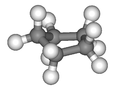 3D envelope
 -
 Half-chair


References
[edit | edit source]- ^ Record of cyclopentane in the GESTIS Substance Database of the Institute for Occupational Safety and Health, accessed on 28 February 2015.
- ^ Lua error in Module:Citation/CS1/Configuration at line 2172: attempt to index field '?' (a nil value).
- ^ a b c d e Lua error in Module:Citation/CS1/Configuration at line 2172: attempt to index field '?' (a nil value).
- ^ Lua error in Module:Citation/CS1/Configuration at line 2172: attempt to index field '?' (a nil value).
- ^ Lua error in Module:Citation/CS1/Configuration at line 2172: attempt to index field '?' (a nil value).
- ^ Lua error in Module:Citation/CS1/Configuration at line 2172: attempt to index field '?' (a nil value).
- ^ Greenpeace - Appliance Insulation Archived 2008-10-30 at the Wayback Machine
- ^ Lua error in Module:Citation/CS1/Configuration at line 2172: attempt to index field '?' (a nil value).
- ^ Lua error in Module:Citation/CS1/Configuration at line 2172: attempt to index field '?' (a nil value).
- ^ Lua error in Module:Citation/CS1/Configuration at line 2172: attempt to index field '?' (a nil value).
- ^ Lua error in Module:Citation/CS1/Configuration at line 2172: attempt to index field '?' (a nil value).
- ^ Lua error in Module:Citation/CS1/Configuration at line 2172: attempt to index field '?' (a nil value).
- ^ Lua error in Module:Citation/CS1/Configuration at line 2172: attempt to index field '?' (a nil value).
- ^ Lua error in Module:Citation/CS1/Configuration at line 2172: attempt to index field '?' (a nil value).
- ^ Lua error in Module:Citation/CS1/Configuration at line 2172: attempt to index field '?' (a nil value).
- ^ Lua error in Module:Citation/CS1/Configuration at line 2172: attempt to index field '?' (a nil value).
External links
[edit | edit source]- Error creating thumbnail: File missing Media related to Lua error in Module:Commons_link at line 62: attempt to index field 'wikibase' (a nil value). at Wikimedia Commons

Lua error in Module:Authority_control at line 153: attempt to index field 'wikibase' (a nil value).