Patella vulgata
| Patella vulgata | |
|---|---|
| File:Common limpets1.jpg | |
| Live Patella vulgata on a rock in Wales | |
| File:Patella vulgata 01.JPG | |
| Shell of Patella vulgata | |
Scientific classification 
| |
| Kingdom: | Animalia |
| Phylum: | Mollusca |
| Class: | Gastropoda |
| Subclass: | Patellogastropoda |
| Family: | Patellidae |
| Genus: | Patella |
| Species: | P. vulgata
|
| Binomial name | |
| Patella vulgata | |
| Synonyms[1] | |
| |
Patella vulgata, common name the common limpet or common European limpet[2] is a species of sea snail. It is a typical true limpet; a marine gastropod mollusc in the family Patellidae, with gills.[1] This species occurs in the waters of Western Europe.
Radula
[edit | edit source]The radula in this species is longer than the shell itself. It contains 1,920 teeth in 160 rows of 12 teeth each. Patella vulgata is found attached to firm substrates from the high shore to the edge of the sublittoral zone, although it predominates in areas of wave action. Its shell is conical, up to around 6 cm long, and lacks defined chirality. Common limpets are believed to be able to live for up to twenty years.[3]
Patella vulgata has been the focus of a range of scientific investigation, as far back as 1935.[4] Its development is well described[5] and it has been the focus of transcriptomic investigation, providing a range of genomic sequence data in this species for analysis.[6]
Their teeth are the strongest natural material known. A study published in the Royal Society journal in 2015 concluded that "the tensile strength of limpet teeth can reach values significantly higher than spider silk, considered to be currently the strongest biological material, and only comparable to the strongest commercial carbon fibres." The material was able to withstand 4.9 GPa. This considerable tensile strength of limpet teeth is attributed to a high mineral volume fraction of reinforcing goethite nanofibres.[7][8][9][10][11]
Human consumption
[edit | edit source]The common limpet was formerly eaten in Ireland, especially during times of hunger such as the Great Famine of 1845–50; it was known to be very tough and had to be thoroughly boiled or roasted to be edible.[12] One Irish proverb said that "Mussels are the food of kings, limpets are the food of peasants."[13] Tomas O'Crohan described eating them in his memoir The Islandman.[14] They are also consumed in Asturias in Spain under the name "Llampares" and in Portugal under the name "Lapas".
See also
[edit | edit source]Gallery
[edit | edit source]-
 Shells of the common limpet from Wales
 -
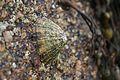 Patella vulgata in litoral of Finistère, near Porspoder - the region affected by the Amoco Cadiz tanker disaster in 1978
 -
 Drawing of the soft body and underside of the shell of Patella vulgata; a) foot b) fringed mantle c) tentacles d) mouth e) eyes f) gills
 -
 Photograph of the soft body and underside
 -
 Radula of Patella vulgata; a) median teeth b) laterals c) uncini or marginals
 -
 Remains of a human meal, limpet shells from Cantabrian Lower Magdalenian layer of the Altamira cave. - MHNT
 -
 Patella vulgata in its natural habitat.


References
[edit | edit source]- ^ a b Gofas, S. (2014). Patella vulgata Linnaeus, 1758. Accessed through: World Register of Marine Species at http://www.marinespecies.org/aphia.php?p=taxdetails&id=140685 on 2014-10-29
- ^ Lua error in Module:Citation/CS1/Configuration at line 2172: attempt to index field '?' (a nil value).
- ^ Lua error in Module:Citation/CS1/Configuration at line 2172: attempt to index field '?' (a nil value).
- ^ Lua error in Module:Citation/CS1/Configuration at line 2172: attempt to index field '?' (a nil value).
- ^ Lua error in Module:Citation/CS1/Configuration at line 2172: attempt to index field '?' (a nil value).
- ^ Lua error in Module:Citation/CS1/Configuration at line 2172: attempt to index field '?' (a nil value).
- ^ Lua error in Module:Citation/CS1/Configuration at line 2172: attempt to index field '?' (a nil value).
- ^ Webb, Jonathan. "Limpet teeth set new strength record" BBC News, 18 February 2015. Archived February 18, 2015, at the Wayback Machine
- ^ Lua error in Module:Citation/CS1/Configuration at line 2172: attempt to index field '?' (a nil value).
- ^ Lua error in Module:Citation/CS1/Configuration at line 2172: attempt to index field '?' (a nil value).
- ^ Lua error in Module:Citation/CS1/Configuration at line 2172: attempt to index field '?' (a nil value).
- ^ Lua error in Module:Citation/CS1/Configuration at line 2172: attempt to index field '?' (a nil value).
- ^ Lua error in Module:Citation/CS1/Configuration at line 2172: attempt to index field '?' (a nil value).
- ^ Lua error in Module:Citation/CS1/Configuration at line 2172: attempt to index field '?' (a nil value).
- Linnaeus, C. (1758). Systema Naturae per regna tria naturae, secundum classes, ordines, genera, species, cum characteribus, differentiis, synonymis, locis. Editio decima, reformata. Laurentius Salvius: Holmiae. ii, 824 pp. Archived 2017-06-13 at the Wayback Machine
- Lespinet, Nederbragt, Cassan, Dictus, Van Loon, et al. Characterisation of two snail genes in the gastropod mollusc Patella vulgata. Implications for understanding the ancestral function of the snail-related genes in Bilateria. 2002.
External links
[edit | edit source]
- Entry in Encyclopedia of Life
- MarLIN species information
- Live underwater image
- BBC Info retrieved 2012
- FSC Info- great pix Retrieved 2012 Archived 2020-09-30 at the Wayback Machine
- Photos of Patella vulgata in the Sealife Collection


Lua error in Module:Taxonbar at line 165: attempt to index field 'wikibase' (a nil value).