Boy's surface

In geometry, Boy's surface is an immersion of the real projective plane in three-dimensional space. It was discovered in 1901 by the German mathematician Werner Boy, who had been tasked by his doctoral thesis advisor David Hilbert to prove that the projective plane could not be immersed in three-dimensional space.
Boy's surface was first parametrized explicitly by Bernard Morin in 1978.[1] Another parametrization was discovered by Rob Kusner and Robert Bryant.[2] Boy's surface is one of the two possible immersions of the real projective plane which have only a single triple point.[3]
Unlike the Roman surface and the cross-cap, it has no other singularities than self-intersections (that is, it has no pinch-points).
Parametrization
[edit | edit source]
Boy's surface can be parametrized in several ways. One parametrization, discovered by Rob Kusner and Robert Bryant,[4] is the following: given a complex number w whose magnitude is less than or equal to one (), let
and then set
we then obtain the Cartesian coordinates x, y, and z of a point on the Boy's surface.
If one performs an inversion of this parametrization centered on the triple point, one obtains a complete minimal surface with three ends (that's how this parametrization was discovered naturally). This implies that the Bryant–Kusner parametrization of Boy's surfaces is "optimal" in the sense that it is the "least bent" immersion of a projective plane into three-space.
Property of Bryant–Kusner parametrization
[edit | edit source]
If w is replaced by the negative reciprocal of its complex conjugate, then the functions g1, g2, and g3 of w are left unchanged.
By replacing w in terms of its real and imaginary parts w = s + it, and expanding resulting parameterization, one may obtain a parameterization of Boy's surface in terms of rational functions of s and t. This shows that Boy's surface is not only an algebraic surface, but even a rational surface. The remark of the preceding paragraph shows that the generic fiber of this parameterization consists of two points (that is that almost every point of Boy's surface may be obtained by two parameters values).
Relation to the real projective plane
[edit | edit source]Let be the Bryant–Kusner parametrization of Boy's surface. Then
This explains the condition on the parameter: if then However, things are slightly more complicated for In this case, one has This means that, if the point of the Boy's surface is obtained from two parameter values: In other words, the Boy's surface has been parametrized by a disk such that pairs of diametrically opposite points on the perimeter of the disk are equivalent. This shows that the Boy's surface is the image of the real projective plane, RP2 by a smooth map. That is, the parametrization of the Boy's surface is an immersion of the real projective plane into the Euclidean space.
Symmetries
[edit | edit source]Boy's surface has 3-fold symmetry. This means that it has an axis of discrete rotational symmetry: any 120° turn about this axis will leave the surface looking exactly the same. The Boy's surface can be cut into three mutually congruent pieces.
Applications
[edit | edit source]Boy's surface can be used in sphere eversion as a half-way model. A half-way model is an immersion of the sphere with the property that a rotation interchanges inside and outside, and so can be employed to evert (turn inside-out) a sphere. Boy's (the case p = 3) and Morin's (the case p = 2) surfaces begin a sequence of half-way models with higher symmetry first proposed by George Francis, indexed by the even integers 2p (for p odd, these immersions can be factored through a projective plane). Kusner's parametrization yields all these.
Models
[edit | edit source]
Model at Oberwolfach
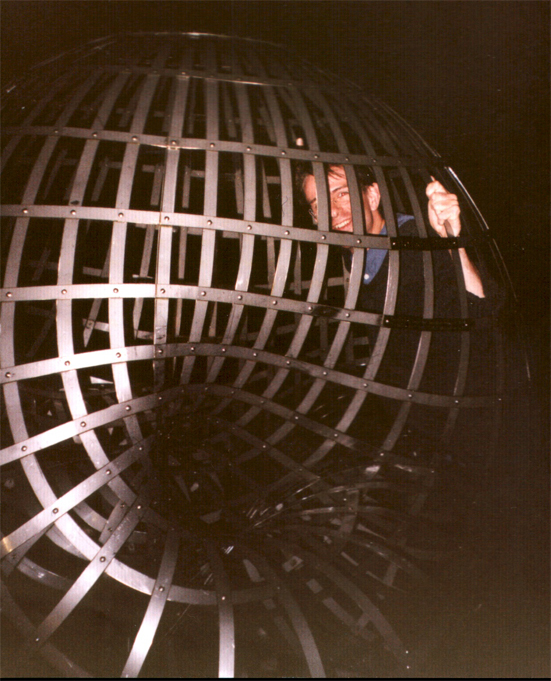
[edit | edit source]The Oberwolfach Research Institute for Mathematics has a large model of a Boy's surface outside the entrance, constructed and donated by Mercedes-Benz in January 1991. This model has 3-fold rotational symmetry and minimizes the Willmore energy of the surface. It consists of steel strips representing the image of a polar coordinate grid under a parameterization given by Robert Bryant and Rob Kusner. The meridians (rays) become ordinary Möbius strips, i.e. twisted by 180 degrees. All but one of the strips corresponding to circles of latitude (radial circles around the origin) are untwisted, while the one corresponding to the boundary of the unit circle is a Möbius strip twisted by three times 180 degrees — as is the emblem of the institute (Mathematisches Forschungsinstitut Oberwolfach 2011).
Model made for Clifford Stoll
[edit | edit source]A model was made in glass by glassblower Lucas Clarke, with the cooperation of Adam Savage, for presentation to Clifford Stoll. It was featured on Adam Savage's YouTube channel, Tested. All three appeared in the video discussing it.[5]
References
[edit | edit source]Citations
[edit | edit source]- ^ Lua error in Module:Citation/CS1/Configuration at line 2172: attempt to index field '?' (a nil value).
- ^ Lua error in Module:Citation/CS1/Configuration at line 2172: attempt to index field '?' (a nil value)..
- ^ Lua error in Module:Citation/CS1/Configuration at line 2172: attempt to index field '?' (a nil value).
- ^ Lua error in Module:Citation/CS1/Configuration at line 2172: attempt to index field '?' (a nil value).
- ^ Lua error in Module:Citation/CS1/Configuration at line 2172: attempt to index field '?' (a nil value).
Sources
[edit | edit source]- Lua error in Module:Citation/CS1/Configuration at line 2172: attempt to index field '?' (a nil value). This describes a piecewise linear model of Boy's surface.
- Lua error in Module:Citation/CS1/Configuration at line 2172: attempt to index field '?' (a nil value). Article on the cover illustration that accompanies the Rob Kirby article.
- Lua error in Module:Citation/CS1/Configuration at line 2172: attempt to index field '?' (a nil value)..
- Sanderson, B. Boy's will be Boy's, (undated, 2006 or earlier).
- Lua error in Module:Citation/CS1/Configuration at line 2172: attempt to index field '?' (a nil value).
External links
[edit | edit source]
- Boy's surface at MathCurve; contains various visualizations, various equations, useful links and references
- A planar unfolding of the Boy's surface – applet from Plus Magazine.
- Boy's surface resources, including the original article, and an embedding of a topologist in the Oberwolfach Boy's surface.
- A LEGO Boy's surface
- A paper model of Boy's surface – pattern and instructions
- A model of Boy's surface in Constructive Solid Geometry together with assembling instructions
- Boy's surface visualization video from the Mathematical Institute of the Serbian Academy of the Arts and Sciences
- This Object Should've Been Impossible to Make Adam Savage making a museum stand for a glass model of the surface