Beit HaShita
Beit HaShita
| |
|---|---|
 View of Beit HaShita | |
| Etymology: House of the Acacia | |
| Lua error in Module:Location_map at line 411: Malformed coordinates value. | |
| Coordinates: Lua error in Module:Coordinates at line 489: attempt to index field 'wikibase' (a nil value). | |
| Country | File:Flag of Israel.svg Israel |
| District | Northern |
| Council | Gilboa |
| Affiliation | Kibbutz Movement |
| Founded | 12 December 1935[1] |
| Founded by | Kvutzat HaHugim-HaMahanot HaOlim members |
| Population (2023)[2] | 1,464 |
| Website | beithashita.org.il |
Beit HaShita (Hebrew: בית השיטה, lit. 'House of the Acacia') is a kibbutz in northern Israel, under the jurisdiction of Gilboa Regional Council. As of 2023 it had a population of 1,464.[2]
Geography
[edit | edit source]The built-up area of Beit Hashita ranges from 70 meters below sea level to sea level.[3]
History
[edit | edit source]Source:[4]
The kibbutz traces its origin to a group meeting held in Hadera in 1928, by "Kvuzat HaHugim" of the HaMahanot HaOlim movement from Haifa and Jerusalem.[5] The first members lived at nearby Ein Harod until 1934, when establishment of the kibbutz began at its present location about 1 km east of Shatta.[5]
The land of the kibbutz was purchased by the Palestine Land Development Company from its Arab owners in 1931.[6][7] In 2015, a grandchild of kibbutz residents, Jasmine Donahaye, published Losing Israel in which she expressed her disillusionment on learning of the eviction of Arabs on the founding of the kibbutz.[8]
The kibbutz was later named after the biblical town Beit Hashita, where the Midianites fled after being beaten by Gideon (Judges 7:22),[9][10] thought to be located where Shatta was. It falls under the jurisdiction of Gilboa Regional Council.
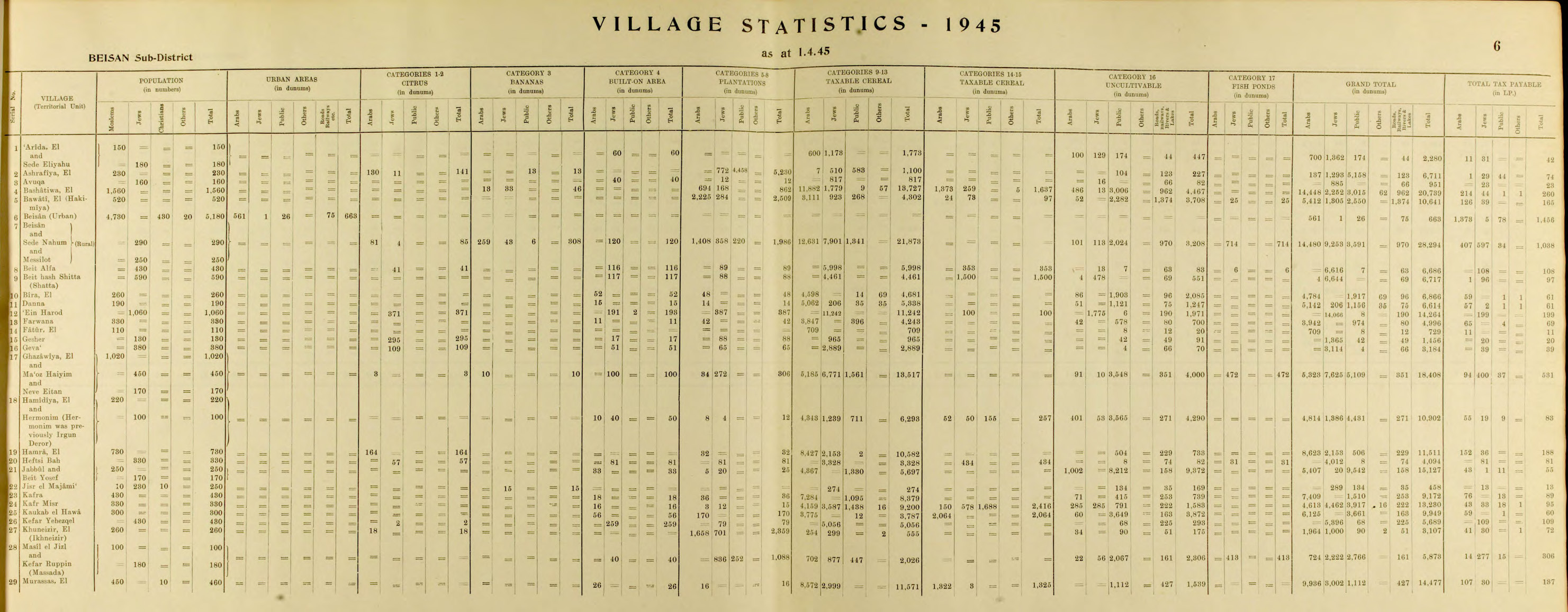
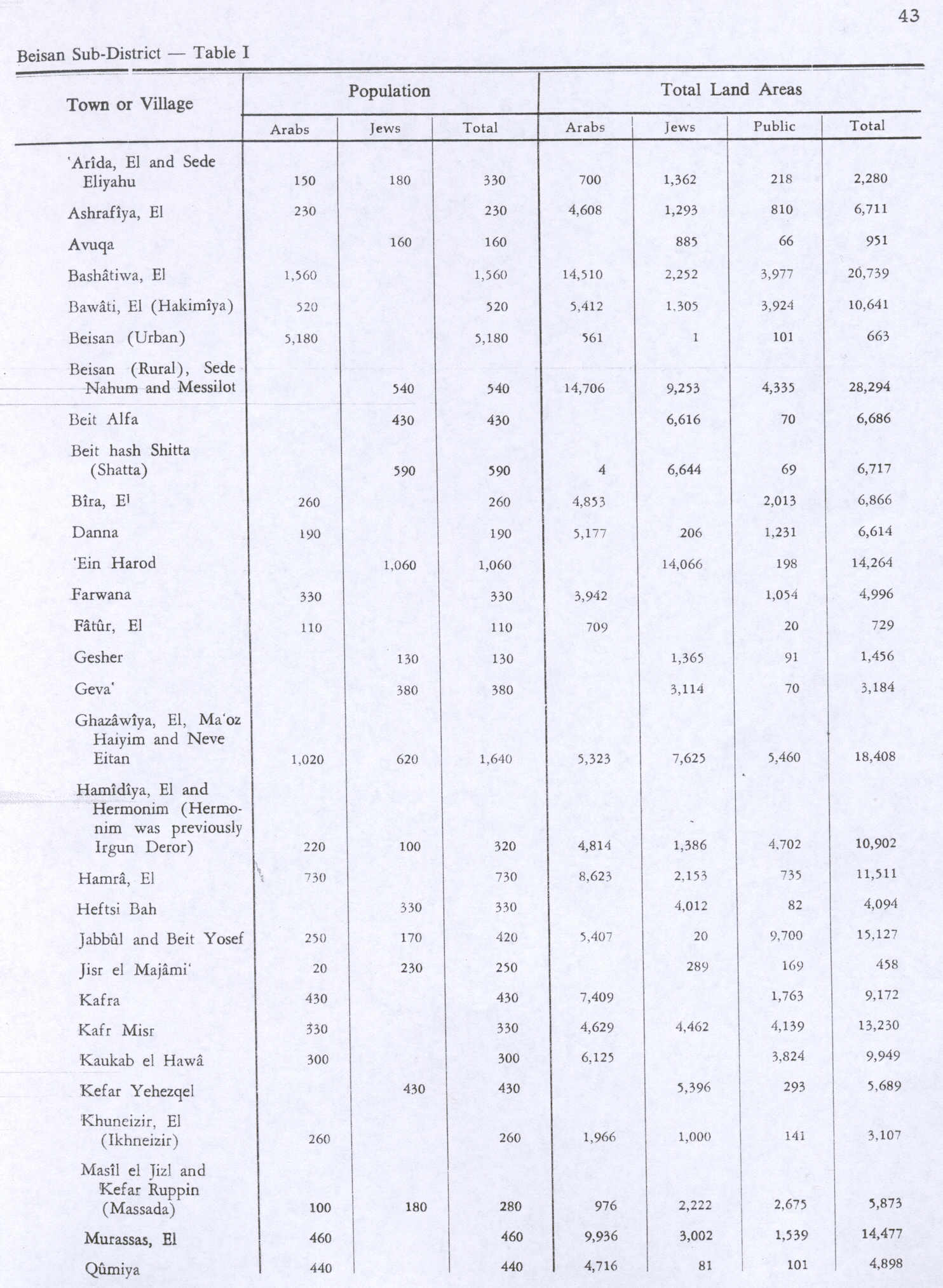
In the 1945 statistics, Beit hash Shitta had 590 inhabitants, all Jews. It was noted that Shatta was an alternative name.[11][12]
-
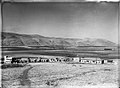 Beit HaShita 1940
 -
 Beit HaShita 1940
 -
 Beit HaShita 1945
 -
 Palmach camp at Beit HaShita, 1947
.-JNF045560.jpeg)
.-JNF045559.jpeg)


Post-1948
[edit | edit source]In 1948, Beit HaShita took over 5,400 dunams of land from the newly depopulated Arab villages of Yubla and Al-Murassas.[13]
Eleven kibbutz members fell during the 1973 Yom Kippur War, the largest number as a percentage of the population than any other town in Israel.[14]
Economy
[edit | edit source]Beit Hashita produced cotton, wheat, melons, olives and citrus fruits. There was also a dairy barn, chickens and a fish farm. In the 1960s, Beit HaShita established a pickling factory which produces and markets pickles, olives and pickled vegetables under the brand name Beit HaShita.[15] The factory also produces syrups for making juices under the brand name Vitaminchick. The factory was bought from the kibbutz in 1998 by the Israeli food manufacturer, Osem.[16]
Religion and culture
[edit | edit source]The Kibbutz Institute for Holidays and Jewish Culture, an organization that preserves the cultural heritage of the kibbutz, was established by kibbutz member Aryeh Ben-Gurion, nephew of Israeli Prime Minister David Ben-Gurion.[17] Beit Hashita served as the basis for the 1981 English language book Kibbutz Makom, which described the kibbutz society.[18] Many of the member families of the kibbutz are secular.[citation needed] There is however a small orthodox synagogue.[citation needed]
Notable people
[edit | edit source]References
[edit | edit source]- ^ State of Israel (1952) Supplement page III
- ^ a b Lua error in Module:Citation/CS1/Configuration at line 2172: attempt to index field '?' (a nil value).
- ^ Survey of Israel, Topographic map
- ^ Mills, 1932, p. 80
- ^ a b Lua error in Module:Citation/CS1/Configuration at line 2172: attempt to index field '?' (a nil value).
- ^ Stein, 1984, pp. 125,134,263–264.
- ^ Kark, 1997
- ^ Nathan Abrams, A Disillusioned Zionist's Bird’s-eye View of Israel, Haaretz, 4 September 2015.
- ^ Carta's Official Guide to Israel and Complete Gazetteer to all Sites in the Holy Land. (3rd edition 1993) Jerusalem, Carta, p. 110, Lua error in Module:Citation/CS1/Configuration at line 2172: attempt to index field '?' (a nil value). (English)
- ^ Yizhaqi, Arie (ed.): Madrich Israel (Israel Guide: An Encyclopedia for the Study of the Land), Vol.8: The Northern Valleys, Samaria and Mount Carmel, Jerusalem 1980, Keter Press, p.401 (Hebrew)
- ^ Department of Statistics, 1945, p. 6
- ^ Government of Palestine, Department of Statistics. Village Statistics, April, 1945. Quoted in Hadawi, 1970, p. 43
- ^ Fischbach, 2012, p. 13
- ^ Lua error in Module:Citation/CS1/Configuration at line 2172: attempt to index field '?' (a nil value).
- ^ Lua error in Module:Citation/CS1/Configuration at line 2172: attempt to index field '?' (a nil value).
- ^ Lua error in Module:Citation/CS1/Configuration at line 2172: attempt to index field '?' (a nil value).
- ^ Lua error in Module:Citation/CS1/Configuration at line 2172: attempt to index field '?' (a nil value).
- ^ Lua error in Module:Citation/CS1/Configuration at line 2172: attempt to index field '?' (a nil value).
Bibliography
[edit | edit source]- Lua error in Module:Citation/CS1/Configuration at line 2172: attempt to index field '?' (a nil value).
- Lua error in Module:Citation/CS1/Configuration at line 2172: attempt to index field '?' (a nil value).
- Lua error in Module:Citation/CS1/Configuration at line 2172: attempt to index field '?' (a nil value).
- Lua error in Module:Citation/CS1/Configuration at line 2172: attempt to index field '?' (a nil value).
- Lua error in Module:Citation/CS1/Configuration at line 2172: attempt to index field '?' (a nil value).
- Lua error in Module:Citation/CS1/Configuration at line 2172: attempt to index field '?' (a nil value).
- Lua error in Module:Citation/CS1/Configuration at line 2172: attempt to index field '?' (a nil value).
- Lua error in Module:Citation/CS1/Configuration at line 2172: attempt to index field '?' (a nil value).
External links
[edit | edit source]- Official website
- Kibbutz Beit HaShita Collection on the Digital collections of Younes and Soraya Nazarian Library, University of Haifa