(119979) 2002 WC19
 2002 WC19 and its satellite imaged by the Hubble Space Telescope in 2006 | |
| Discovery | |
|---|---|
| Discovered by | Palomar Observatory |
| Discovery date | 16 November 2002 |
| Designations | |
| (119979) 2002 WC19 | |
| Twotino[1][2] binary | |
| Orbital characteristics[3] | |
| Epoch 13 January 2016 (JD 2457400.5) | |
| Uncertainty parameter 3 | |
| Observation arc | 3978 days (10.89 yr) |
| Aphelion | 60.732 AU (9.0854 Tm) |
| Perihelion | 35.289 AU (5.2792 Tm) |
| 48.010 AU (7.1822 Tm) | |
| Eccentricity | 0.26498 |
| 332.67 yr (121,507 d) | |
| 316.02° | |
| 0° 0m 10.666s / day | |
| Inclination | 9.1746° |
| 109.7547° | |
| ≈ 5 November 2056[4] ±3 days | |
| 44.356° | |
| Known satellites | 1 (81 km)[5] |
| Earth MOID | 34.3056 AU (5.13204 Tm) |
| Jupiter MOID | 29.9229 AU (4.47640 Tm) |
| Physical characteristics | |
| Dimensions | 338 km[5] |
| Mass | (8.13±1.0)×1019 kg (prograde) or (7.263±0.87)×1019 kg (retrograde) [6] |
Mean density | 1.97 g/cm3[5] |
| 0.05[5] | |
| 4.9 | |
(119979) 2002 WC19 (provisional designation 2002 WC19) is a twotino, that is, a trans-Neptunian object in a 1:2 orbital resonance with Neptune. It was discovered on November 16, 2002 at the Palomar Observatory. If its derived diameter is correct it would have a higher density than Pluto, which is unusual as it appears to be much smaller than the expected size at which a Kuiper belt object usually becomes solid.
Knowing how many twotinos there are may reveal whether Neptune took roughly 1 million or 10 million years to migrate about 7 AU from its birth location.[7]
Satellite
[edit | edit source]| Discovery | |
|---|---|
| Discovered by | K. S. Noll, W. M. Grundy, S. D. Kern, H. F. Levison, D. C. Stephens |
| Discovery site | Hubble Space Telescope |
| Discovery date | 5 November 2006 |
| Orbital characteristics[5] | |
| 4092±94 km | |
| Eccentricity | 0.21±0.05 |
| 8.403±0.001 d | |
| Inclination | 24.0°±0.7° |
| Satellite of | (119979) 2002 WC19 |
| Physical characteristics | |
| 81 km (assuming similar albedo)[5] | |
| primary + 2.5 | |
On February 27, 2007, a natural satellite was reported to be orbiting 2002 WC19. It is estimated to be 4092±94 km from the primary, with an orbital period of 8.403±0.001 days, an eccentricity of 0.21±0.05 and an inclination of 24.0°±0.7°. Assuming similar albedos, it is a quarter the diameter of its primary, or around 81 kilometres (50 mi) in diameter.[5]
-
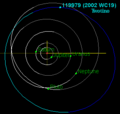 Orbit of 2002 WC19 compared to Pluto and Neptune
 -
 1:2 libration over 20,000 years – Neptune is held stationary (dot at 5 o'clock); orbit of Uranus in blue


References
[edit | edit source]- ^ Lua error in Module:Citation/CS1/Configuration at line 2172: attempt to index field '?' (a nil value).
- ^ Lua error in Module:Citation/CS1/Configuration at line 2172: attempt to index field '?' (a nil value).
- ^ Lua error in Module:Citation/CS1/Configuration at line 2172: attempt to index field '?' (a nil value).
- ^ JPL Horizons Observer Location: @sun (Perihelion occurs when deldot changes from negative to positive. Uncertainty in time of perihelion is 3-sigma.)
- ^ a b c d e f g Lua error in Module:Citation/CS1/Configuration at line 2172: attempt to index field '?' (a nil value).
- ^ Lua error in Module:Citation/CS1/Configuration at line 2172: attempt to index field '?' (a nil value).
- ^ Lua error in Module:Citation/CS1/Configuration at line 2172: attempt to index field '?' (a nil value).
External links
[edit | edit source]- (119979) 2002 WC19 at the JPL Small-Body DatabaseLua error in Module:WikidataCheck at line 29: attempt to index field 'wikibase' (a nil value).
Lua error in Module:Authority_control at line 153: attempt to index field 'wikibase' (a nil value).